Any good jazz musician spends a great deal of time working as a sideman, but the best musicians show up consistently in high profile positions. Their insightful musicianship leaps out of any setting, making them a magnet for audience and peer attention. As a result, they regularly have a full schedule as one gig leads to another opportunity, opening into yet more performances. Once word spreads, they generally attract major attention, leading to gigs with the best musicians in their field and beyond. As their profile rises, they become important pieces of the scene, and eventually, they make the step into the role of bandleader.
Brazilian pianist Helio Alves has served as a high profile sideman with some important names in the jazz and Latin Jazz world, a reflection of his finely tuned skills currently on display in his own project. Born and raised in Sao Paulo, Brazil, Alves found musical inspiration in his parents, who both maintained their skills as amateur pianists. Classical music was a priority in the Alves household, with a bit of jazz thrown into the mix, giving young Helio a strong foundation.
He dove into classical lessons at 6 years old, getting a strict training until a concert from pianist Chick Corea and vibraphonist Gary Burton turned his attention towards jazz. During his high school years, Alves received encouragement and lessons from jazz bassist Xu Viana, who suggested that the young pianist continue his jazz studies at the Berklee College Of Music.
Alves moved to Boston after high school, taking Berklee by storm with continually impressive showings of musicianship. While at Berklee, Alves connected with trumpet player Claudio Roditi, and after moving to New York upon graduation, Alves found a spot in Roditi’s band at the piano chair. While working steadily with Roditi, Alves also found a prime gig in saxophonist Joe Henderson’s Double Rainbow Quartet, recording with the jazz legend on his album Big Band.
Alves became a first call pianist on New York’s Brazilian Jazz scene, working with harmonica player Hendrik Meurkens on In A Sentimental Mood, drummer Duduka da Fonseca on Samba Jazz Fantasia, saxophonist Paquito D’Rivera on Brazilian Dreams, among many others. As the pianist’s schedule began to fill with calls from across the scene, he also began a career as a bandleader on the 1998 album Trios. An inspired collection of straight-ahead jazz and Brazilian Jazz, Alves recorded with two trios including bassist John Patitucci and drummer Al Foster as well as bassist Nilson Matta and da Fonseca. Alves followed this release in 2004 with Portrait in Black and White, another strong trio release that teamed the pianist with bassist Santi Debriano and drummer Matt Wilson.
In 2009, Alves kicked things up a notch with It’s Clear, a quartet recording that employed guitarist Romero Lubambo, bassist Scott Colley, and drummer Ernesto Simpson. Along the way, the pianist took high profile jobs with cellist Yo-Yo Ma on Obrigado Brazil and co-lead the album Forests with Matta and da Fonseca. His 2010 release Música teams the pianist with bassist Reuben Rogers and drummer Antonio Sanchez, a trio complimented in two spots by Roditi and Lubambo. It’s another step for Alves in the transition from high profile sideman to high profile bandleader, as he once again showcases impeccable musicianship throughout the recording.
Until relatively recently, artistically satisfying collaborations between jazz instrumentalists and string sections were so rare that they might be counted on the fingers of one hand – once Stan Getz's Focus and Ian Carr's Spirit of Place had been routinely nodded to, and the controversial merits/demerits of Clifford Brown's and Charlie Parker's recordings debated, little remained to be said – these days, however (in the UK alone), with Basquiat Strings, Phil Robson's Six Strings and the Beat, Gilad Atzmon et al. mixing jazz and string playing with ease and grace, the field is a healthy-sized one.
Russian trumpeter Vyacheslav Guyvoronsky has apparently long wished to contribute to the genre, which perhaps accounts for his having so discernibly wished to touch all possible bases in this recording, on which he is joined by violinists Vladislav Pesin and Dmitry Yakubovsky and cellist Mikhail Degtyarev.
22.05.2010. День рождения Культурного Центра ДОМ. Выступление трио Гайворонский - Кондаков - Волков.
Vyacheslav Guyvoronsky - trumpet;
Andrei Kondakov - piano, percussion;
Vladimir Volkov - bass
UNT alumna Carolina Araoz and her colleagues are doing great work at their school, Jazz Jaus, in Lima, Peru. Here's a video about it. Opening of the narration: "We are Jazz Jaus: a music school and non-profit organization whose main goal is to change lives through music." The school offers instruction in jazz and classical music. It's based in Lima and is also active in other cities in Peru.
In the 1990s, Houston Person kept the soulful thick-toned tenor tradition of Gene Ammons alive, particularly in his work with organists. After learning piano as a youth, Person switched to tenor. While stationed in Germany with the Army, he played in groups that also included Eddie Harris, Lanny Morgan, Leo Wright, and Cedar Walton. Person picked up valuable experience as a member of Johnny Hammond's group (1963-1966) and has been a bandleader ever since, often working with singer Etta Jones.
A duo recording with Ran Blake was a nice change of pace, but most of Houston Person's playing has been done in blues-oriented organ groups. He has recorded a consistently excellent series of albums for Muse, eventually switching to HighNote Records for 2006's You Taught My Heart to Sing, 2007's Thinking of You, and 2008's Just Between Friends, which featured bassist Ron Carter.
To truly understand the big band era, you have to think of orchestra leaders as inventors. Instead of building better mousetraps, they assembled bands. And reassembled them. And reassembled them again. Three factors drove the tinkering: First were the commercial pressures to create music that large numbers of people would pay to hear. Second was the need to replace band members who departed or defected to other bands. And third was a personal and competitive search for the sound they heard in their heads. In the inventor's lab, this is called vision. Gene Krupa was one of those visionaries, the results of which can be found on the CD Hop, Skip and Jump—1946 (Vol. 3) from Hep Records.
In 1946 and early 1947, the economics of running a big band were growing increasingly difficult. Tastes were shifting, live music was being replaced by records on the radio and jukeboxes, and many Americans psychologically were exhausted by the war and preferred more mellow, home-bound diversions.
But the big band era didn't come to a resounding end the moment the war ended. In fact, no one knew that the swing era was finished until writers made the observation several years later. Swing bands still dominated the airwaves and record sales in 1946 and 1947, though they clearly weren't enjoying pre-war levels of box-office success or the frenzied popularity of earlier years.
By late 1948, bebop influences were seeping into bands' song books as better musicians and arrangers mastered the new music found on records by 52nd Street artists. A recording strike in 1948 also forced most prominent big bands to sound hipper and fresher, since radio remotes were the only way for them to deliver new music to listeners.
So 1946 and 1947 were limbo years for swing bands, with most people in the music business assuming that the big band era would continue on. When you listen to the band music of this two-year period, you immediately sense that most bandleaders were taking a wait and see approach stylistically. Or they were experimenting gingerly with their personnel and arrangements to update the sound of their books. Ballads and romantic treatments also were favored to slake the public's demand for softer stuff.
Krupa was no exception. This CDof music from the two-year period illustrates this trend neatly. The discography begins around the time Anita O'Day famously walked off the stage in Hollywood in January 1946 and never returned to the band. Throughout 1946, changes to the Krupa band came as the orchestra embarked on national tours. Soon, soloists like Charlie Ventura and Red Rodney left the band to start bebop careers while others like vocalist Buddy Stewart simply tired of bi-coastal road trips.
By January 1947, Krupa had many new players with an emphasis on trumpet section. In March, the band's horn section shifted for a trip to New York with Ed Badgley, Al Porcino, Ray Triscari and Don Fagerquist [pictured] in place. In July, most of the trumpets were swapped out when the band arrived back in Hollywood (Johnny Bello, Ray Triscari, Gordon Boswell and Dick Dale).
The music throughout is evenly paced, clinging to past band models but updating the band's sound. King Porter Stomp is a perfect example of this retooling, as is Out of Nowhere, with a fabulously studied tenor sax solo by Ventura. There are plenty of vocal tracks, another sign that the past was still very much part of the present.
Featured singers were Anita O'Day (one track), Carolyn Grey, Buddy Stewart, Buddy Hughes and Dolores Hawkins. And Charlie Kennedy's alto saxophone can be heard throughout.
What is particularly delightful about this CD are the arrangements. Nearly all were by George Williams, who had a knack for keeping sections hopping and interacting with a big sound. Williams take on KIng Porter Stomp is a rich detailing of a swing era hit. In the Moon Mist perfectly exemplifies the new harmonic approach. There's even a ballad trumpet solo by Red Rodney [pictured] and an outro series of chords that will knock you out. Williams' soft touch is found on How Deep Is the Ocean with vocalist Buddy Stewart and He's Funny That Way with Carolyn Grey.
By late 1947, Krupa was leading a band that was already influenced by bebop and bebop musicians. In his book were songs like Ed Finkel's Calling Dr. Gillespie and Up an Atom as well as Gerry Mulligan's Disc Jockey Jump. This CD provides us with a last look at Krupa's attempts to hold onto the swing era even as it slipped slowly into the rear-view mirror.
Ms. Jackson is a New York/New Jersey... based jazz vocal stylist, and is available worldwide for festivals, clubs, concert tours and clinics... as a soloist, or with her Jazzin' All Star Band..."A true ensemble performance...every tune is a musical collaboration..effortless, natural and unscripted" Carrie is considered one of the most consistently interesting singers in the metropolitan area, and is one of the top jazz artist's around today providing for classical performances in jazz favorites, soulful sultry pop, blues and poignant mellow gospel.
She combines jazz originals, standards, pop/blues tunes, and open improvisation in an adventurous, genre-bending style that's inspirational and original; a singer with a Sound! Carrie Jackson & Her Jazzin' All Star Ensemble swing and perform the music of "Duke" Ellington, Count Basie, Lionel Hampton, Louis "Satchmo" Armstrong, Miles Davis, John Coltrane, Dizzy Gillespie, and musical selections songs from the Great American Song Book.
Carrie is a native Newarker' who nurtured and honed her talents in Newark, the Jazz Mecca of New Jersey. She has acquired a vast amount of experience in a wide variety of musical genres. She began her musical career when she was 6 years old singing in the children's choir at Mount Calvary Baptist Church, Newark, NJ. Carrie is a product of the Newark Public School system; attended Peshine Avenue Elementary School, and Weequahic H.S.
Carrie studied piano and voice with Howard "Duke" Anderson, teacher, composer and arranger. She is a protégé of Duke's artistry and learned the music business from him. Under "Duke's tutelage she became an accomplished seasoned singer as well as band leader. As a young adult Carrie worked as a featured vocalist with Duke Anderson's Big Band. She also studied voice with Inez Mc Clendon, Nadine Herman and Winston Hughes at NCSA in Newark, NJ. Her voice training and natural talents are evident that the voice is indeed the "first instrument." The way Carrie elicits emotion and passion suggests she actually cares about singing, and is not simply going through the motions making her a true ambassador of Jazz!
Carrie rekindles thoughts of America's great jazz history, and attributes her vocal style of singing to her mentors, the Great Ladies of Jazz, Sarah "Sassy" Vaughan, Ella Fitzgerald, Billie Holiday, Dinah Washington, Nancy Wilson, and Carmen Mc Rae. Newark's notable musicians include, Wayne Shorter, Woody Shaw, James Moody, Ike Quebec, just to name a few. She has taken all of her mentors and made them a part of her, and brings new horizons to America's classical art form "Jazz", the truth is, she has a bit of all them and more that is uniquely her own. Carrie's smooth, sultry, soulful sound has captivated thousands, and she maintains a uniqueness that is her own and proudly carries the jazz banner with her own enchanting style.
Ms. Jackson, jazz song stylist, has been hailed a "Diva" for her featured artist performance concert in " Women in Jazz" Newark Jazz Festival, Newark, NJ. She was a principal performer in "Ain't Misbehavin'", Thomas "Fats"Waller's musical at the Villagers Theater, New Brunswick, NJ. This show was a huge success and had a 6 week run. She was a principal artist in " 49th Street Jazz"a musical review and tribute to Eubie Blake, Duke Ellington, Billie Holiday, Alberta Hunter, which featured selections from Eubie, Sophisticated Ladies, Black & Blue, Porgy & Bess, and Ain't Misbehavin', by Thomas Fat's Waller, Spectrum (Play) The Life of Christ, lead role, Elizabeth, Director/Writer: Henry Bobbitt, Montclair, NJ.
Ms. Jackson is President/CEO of C-Jay Records and C-Jay Recording & Productions, Inc., established in 1996. She has produced several CD's including her critically-acclaimed debut compact disc, entitled "THE NEARNESS OF YOU" (C-Jay Records), a collaboration with Co-Producer, Cecil Brooks III, drms, Howard "Duke" Anderson, pn/ arrangements, Michael Logan, bs, Bruce Williams, sax, and most recent CD " IF I HAD MY WAY" co-produced by Lennie Argese, gtr.
This latest CD put Ms. Jackson in the Critic's Poll list of "Talent Deserving Wider Recognition. Carrie is accompanied by Tomoko Ohno, pn, Steve Freeman, bs, Dr. Yusef Ali, drms, Bob Braye, percussions, Joe Ford, alto/sax, and Herbie Morgan, ten/sax. Her radio appearances include "Singer's Unlimited" WBGO Jazz Radio FM 88.3, Newark, NJ, live interview with on-air host , Michael Bourne, and with on-air host, Mark Blaustein, Montclair State University, Montclair, NJ.
Carrie's travels have taken her to Europe, and touring in the U.S. She has performed with a variety of groups such as "Duke" Anderson Orchestra, Stanley Jordan & Trio, Norman Simmons, Earl May, Lisle Atkinson, Richard Eisenstein, Virginia Mayhew, Dr. Yusef Ali, "Sweet" Sue Terry, James Dean Orchestra, Edward Ellington III, (The Ellington Legacy Band), Chris White, Buddy Terry, Calvin Hughes, Lafayette Harris, Radam Schwartz, Wallace "Corky" Caldwell, Bradford Hayes, Cecil Brooks III, Saul Fischer, James Stewart, Willie Williams, Andy Mc Cloud, Rudy Walker, and others. The spontaneous interplay with her long time band mates, Tomoko Ohno, Lou Rainone, Steve Freeman, and Gordon Lane, creates a unique and captivating ensemble...........
Billie Holiday has one of the most distinctive voices of all time; her very personal style continues to inspire singers decades after her death in 1959. Holiday herself was inspired by great musicians she heard growing up, and it's those influences that helped her become one of the most beloved singers ever.
Holiday became famous after she recorded "Strange Fruit," a 1939 protest song about lynchings of African-Americans. The haunting vocal offers a stark illustration of her greatest gift — the ability to convey emotion.
Phil Schaap, curator of Jazz at Lincoln Center, says Holiday "speaks to your heart. She catches your ear. She reaches your mind, and she does this with an emotional power that, of course, is genius and is beyond words."
The emotional power of Holiday's vocals comes from the way she sings the melodies. It's about rhythm and phrasing, which Holiday learned from listening to the best.
Holiday was born in Philadelphia in 1915, and was raised in Baltimore. As a girl, she loved music, and her idols were Louis Armstrong and blues singer Bessie Smith.
To hear those 1920s records, Holiday needed a Victrola, and the only place she had access to one was Alice Dean's whorehouse, where as a girl Billie worked scrubbing floors.
"A Victrola was a big deal in those days, and there weren't any parlors around that had one except Alice's," Holiday wrote in in her autobiography, Lady Sings the Blues. "I spent many a wonderful hour there listening to Pops and Bessie. I remember Pops' recording of 'West End Blues' and how it used to gas me. It was the first time I ever heard anybody sing without using any words."
Holiday's real vocal influence is Louis "Pops" Armstrong. She heard his Hot Five vocal numbers, and is clearly an Armstrong-inspired singer. Schaap has studied Armstrong's influence on Billie Holiday closely. He's been demonstrating how Holiday mimics Armstrong's phrasing on his radio shows at Columbia University's WKCR for some 30 years.
"You really have to hear it, is what you have to do," Schaap says. "My telling you that the phrasing over the rhythm that Louis Armstrong has is reprised and utilized in Billie Holiday's concept isn't telling you anything unless you actually go hear their records. I'd like you to hear Louis Armstrong and Billie Holiday take a chorus of 'Yours and Mine.' "
Like a scientist in his laboratory, Schaap, in a WKCR studio, takes Armstrong's and Holiday's versions of the same song, recorded in the same year, 1937. Then he adjusts the turntable pitch controls to speed up Armstrong's vocals and slow down Billie's, so that their voices are closer in pitch.
Schaap says if you listen closely, you can hear how similar the phrasing is — how Holiday literally learned how to sing and swing at the same time from Armstrong. "Well, that was Billie Holiday doing Louis Armstrong," Schaap says. "And I think you can hear it. She gets so much from Pops." In 1949, she actually got to sing with him.
Just as Holiday learned from listening to older singers, generations of younger singers have learned from listening to Holiday — from Frank Sinatra to Shelby Lynne. Singer Joni Mitchell says her two favorite singers are Edith Piaf and Billie Holiday because of the way they use their technical gifts as singers to tell meaningful stories.
"I think I took this from Billie and Piaf, that many of the so-called great singers love their notes more than their text," Mitchell says. "And those women never forgot what they were singing about, so that the note almost played second position to the text. Not that there was anything wrong with the chosen notes. There was still beauty to them, but the emphasis was on telling the story from the heart."
Holiday had plenty of stories to tell, and enough heartache to fill a songbook: years of heroin addiction, a stint in federal prison and a series of abusive relationships with men. She was just 44 years old when she died.
Schaap says too much emphasis has been placed on the tragic aspects of Holiday's life, and not enough on the glorious aspects of her voice.
"She swings and invents," he says. "She innovates. She can compose on the fly, she can make you hear the rhythm section if it's not there, and make them play better if they are. And I think that's it. I think Billie Holiday is the greatest."
http://youtube.com/symphony The world's first collaborative online orchestra performed at Carnegie Hall on April 15, 2009. Selected by the YouTube community and several members of the world's most renowned orchestras, the YouTube Symphony Orchestra is made up of over 96 professional and amateur musicians from 30+ countries and territories on six continents and represents 26 different instruments.
Program:
07:15 Johannes Brahms - Allegro giocoso from Symphony No.4 in E minor, Op. 98
17:15 Lou Harrison - Music from Canticle No. 3
27:45 Antonín Dvořák - Music from Serenade in D minor, Op. 44
32:45 Giovanni Gabrieli - Canzon Septimi toni No. 2
38:15 Johann Sebastian Bach - Sarabande from Suite No. 1 in G major, for Cello Solo, VWV 1007 (performed by Joshua Roman)
43:30 Heitor Villa-Lobos - Bachianas brasileiras No. 9
54:00 Richard Wagner - Ride of the Valkyries from Die Walkuere
Special thanks to the following guest artists:
- Joshua Roman
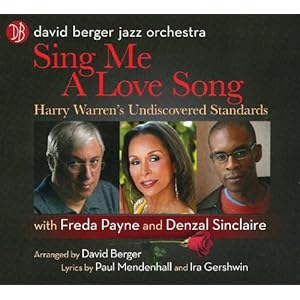
The David Berger Jazz Orchestra – the acclaimed band featured in the Wall Street Journal, National Public Radio and PBS TV – recently released their latest CD, Sing Me A Love Song: Harry Warren's Undiscovered Standards, featuring Freda Payne (“Band Of Gold,” “Bring The Boys Home”) and Denzal Sinclaire (National Jazz Award Winner). The CD has had great radio airplay and was singled out in USA Today's Best Tracks of the Week.
Make sure to check out this great behind-the-scenes look at the the making of Sing Me A Love Song. The video includes interviews with the artists, producers, and creative talent to give you an inside look at the process. The Making of Sing Me A Love Song <http://www.youtube.com/watch?v=DgdqSzigI64>
For the first time ever, these previously unrecorded and unpublished melodies by Harry Warren (1893-1981), the legendary composer of iconic hits like “Lullaby of Broadway,” “At Last” and “Jeepers Creepers,” are seeing the light of day with a thrilling big band sound. Warren – who won three Academy Awards out of eleven nominations – had more songs on the Hit Parade’s Top 10 than Gershwin, Berlin or Porter. These new songs with smart and sophisticated new lyrics written by Paul Mendenhall – appropriate to the period yet never dated – have the quality of Golden Age classics with their beautiful melodies and distinctive hooks. Each sounds like a standard we should already know and love.
The album includes a wide range of styles from the Italian waltz “Positano Afternoon,” the exciting Latin beat of “But Here We Are,” the emotional ballad “I’m Sorry” and the Count Basie-esque instrumental “Double Trouble.” “There Is No Music,” the rarely heard song with lyrics by Ira Gershwin, is another valuable contribution. In addition to the vocal tracks, the CD includes five additional instrumental versions which, as Berger says, “show their beauty and adaptability.”
Sing Me A Love Song features distinctive contributions from Freda Payne – the chart-topping singer, actress and TV personality recently seen on “American Idol” who has an accomplished career as a jazz and ballad vocalist – and the smooth sound of Denzal Sinclaire, one of Canada’s most popular jazz vocalists with his own Bravo TV special and multiple nominations for the prestigious Juno Award.
This new recording, created with the full support of the Harry Warren family, is a follow up to Berger’s acclaimed instrumental jazz Warren collection I Had The Craziest Dream. Berger’s Jazz Orchestra features Jay Brandford, Matt Hong, Dan Block, Mark Hynes, Carl Maraghi on reeds; Bob Millikan, Brian Pareschi, Irv Grossman, Brandon Lee and Scott Wenholt on trumpet; Wayne Goodman, Ryan Keberle and Jeff Bush on trombone; Isaac ben Ayala on piano; Yasushi Nakamura on bass and Jimmy Madison on drums. Berger serves as conductor, arranger and producer. Robert Schwartz and Peter Fannon serve as Executive Producers.
* * * * *
DAVID BERGER, the composer, arranger and conductor is recognized internationally as a leading authority on the music of Duke Ellington and the Swing Era. Conductor and arranger for the Jazz at Lincoln Center Orchestra from its inception in 1988 through 1994, Berger has transcribed more than 700 full scores of classic recordings including nearly 500 works by Duke Ellington and Billy Strayhorn. Mr. Berger maintains a close working relationship with Wynton Marsalis and continues to transcribe and arrange for and conduct the Jazz at Lincoln Center Orchestra.
In 1996 Berger collaborated with choreographer Donald Byrd to create the Harlem Nutcracker, a full-length 2-hour dance piece that expands the Tchaikovsky/Ellington/Strayhorn score into an American classic. The 15-piece band assembled to play this show has stayed together as the Sultans of Swing and tours throughout the United States and Europe. Berger has written music for television (he conducted his band for the Kennedy Center’s “Mark Twain Award for Comedy” given to Billy Crystal), Broadway shows including Sophisticated Ladies; films including The Great Debaters, The Cotton Club and Brighton Beach Memoirs; dozens of singers, bands, orchestras and dance companies.
David Berger’s jazz compositions and arrangements and transcriptions are played by hundreds of bands every day all over the world. A seven-time recipient of National Endowment for the Arts fellowships, Berger resides in New York City. Mr. Berger has transcribed and edited the great majority of the Essentially Ellington music, conducted band workshops, and annually serves as a judge at the Essentially Ellington Competition & Festival.
* * * * *
FREDA PAYNE, best known for her worldwide Top 10 smash “Band Of Gold,” grew up listening to Ella Fitzgerald and Billie Holiday, which inspired her growing interest in music. She began her singing career with commercial jingles in her hometown of Detroit. Freda toured with Quincy Jones during his big band era; performing at the world famous Apollo in New York and the Regal in Chicago, among others. Soon after, she recorded the album When The Lights Go Down for Impulse Records and How Do You Say I Don’t Love You Anymore, for MGM.
She made guest appearances on top television shows including Merv Griffin and Johnny Carson. During this time, a busy Freda also added theatrical credits to her resume. She understudied Leslie Uggams for the Broadway show Hallelujah, Baby! in 1967. In 1969 her hometown friends, brothers Brian & Eddie Holland and Lamont Dozier persuaded Freda to sign with their newly formed label, Invictus. Freda went on to score with two million-selling singles: “Bring The Boys Home” and “Band Of Gold.” She also recorded “Deeper and Deeper,” “Cherish (What’s Dear To You)” and “You Brought The Joy.”
Freda moved to ABC and later Capitol Records, releasing such albums as Payne & Pleasure, Out Of Payne Comes Love and Supernatural High. In the 1980s, Freda concentrated on acting and television, hosting her own talk show, but never entirely losing touch with her music. She recorded a single in 1982 entitled “In Motion” (Sutra), and a remake of “Band of Gold” with Belinda Carlisle in 1986. In the 1990s, Freda recorded several songs for Ian Levine’s UK Motorcity label. The new millennium brought a new album of jazz, pop and R&B called Come See About Me for the Volt label and rave reviews for the show “Love & Payne”, which featured Freda and Darlene Love at Feinstein’s in New York and the Cinegrill in Hollywood. Recently, Freda played a three-month run of Blues in The Night, alongside Maurice Hines at San Francisco’s Post Street Theatre.
* * * * *
DENZAL SINCLAIRE, the Toronto-born vocalist, pianist and composer, has earned his reputation as Canada’s most popular male jazz vocalist. Sinclaire is a graduate of Montreal’s McGill University where he received a Bachelor’s Degree in Jazz Performance. Denzal’s vocal timbre is reminiscent of some of the great singers like Nat King Cole, Johnny Hartman and Johnny Mathis. A multiple Juno Award nominee, and recipient of the 2004 National Jazz Award for “Best Album”, he has graced the stages of numerous jazz festivals, performed with symphony orchestras, and starred in his own one hour television special for BRAVO! In 2005, Denzal was inducted into the British Columbia Entertainment Hall of Fame.
His CDs include I Found Love for EmArcy; Denzal Sinclaire for Verve; and latest release My One and Only Love from Verve, featuring trumpeter Brad Turner, bassist Reuben Rogers, drummer Gregory Hutchinson, guitarist Russell Malone and saxophonist Seamus Blake.
JAZZofilo is a cultural Blog. Our intention is not to commercialize music, but to share with friends the pleasure of listening jazz music and the world of jazz.
The site does not keep music files, but through widgets. You're welcome to submit posts, photos, etc. of jazz related topics.
If for some reason you feel offended by the content of a particular post here that was not our intention. Please let us know and we'll remove it.
Any questions and suggestions, send me to the link: cavalcanticlaudio@yahoo.com