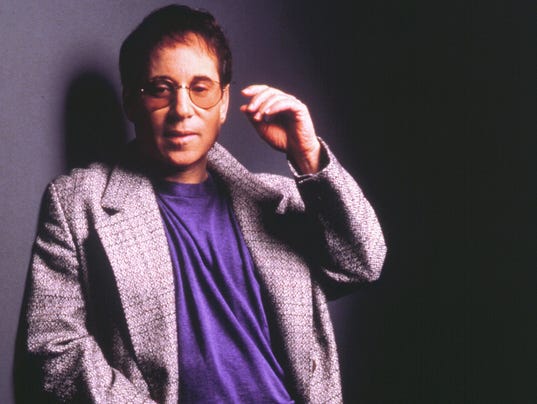
Patrick Foster and Jim Lenahan, USA TODAY 8:07 a.m. EDT May 28, 2016 As great as Simon & Garfunkel were, Paul Simon's solo work is in many ways more impressive. That's because without Art Garfunkel's soaringly beautiful voice to carry the songs, Simon had to find inventive ways to make his music compelling.
As a songwriter, Simon continued to display rare wordsmith skills, commenting on the human condition through vivid stories populated by memorable characters. (Who could forget Julio, going against the law down by the schoolyard? Good thing for the radical priest — and Newsweek.) Every detail in every line was precisely crafted, down to the syllable. read more: http://www.usatoday.com/story/life/music/2016/05/27/dad-rock-podcast-still-crazy-paul-simon/85057332/
By JOHN KELMAN, Published: January 11, 2014 If the history books were to be closed on singer/songwriter Paul Simon's career today, he'd have already left a legacy more than sufficient to ensure a substantial chapter. While other emergent songwriters of his day—Leonard Cohen, Bob Dylan and Randy Newman amongst them—have clearly evolved over the years, there's been an underlying approach that's remained consistent across, in many cases, half a century. That's not to dismiss or denigrate these icons of song, only to say that Simon has emerged as a songwriter who has not just grown as a wordsmith and composer of catchy, memorable music (as they all have); he's the only one to have looked at the world around him, studying and subsuming advancing technology, diverse genres and, perhaps most importantly, the music of other cultures. It's a mindset Simon shares with the slightly younger British songwriter Peter Gabriel—despite their being completely different in their approaches—not just incorporating these diverse and sometimes disparate concepts into his music but, in the case of pan-cultural concerns, actually locating and working with many of the musicians he studied. Nowhere is this clearer than on The Complete Albums Collection, which collects almost every album Simon has released, starting with 1965's The Paul Simon Songbook (Columbia, 1965) through to his most recent studio record, So Beautiful Or So What (Hear Music, 2011). Only the two-CD/1-DVD Live in New York City (Hear Music, 2012), culled from the limited tour Simon launched in support of So Beautiful, is omitted. Over the course of 46 years, The Complete Albums Collection follows Simon as he moves from acoustic guitar-slinging folk singer to jazz-informed popster, African and Brazilian-tinged world traveler, electro-centric explorer and, finally, consolidator of everything that came before. The collection, housed in a pristine white box with magnets to keep the lid closed, places the 15 CDs, comprising 14 separate releases, in miniature (where relevant) replicas of the original vinyl covers, including the gatefold sleeves for albums like 1975's There Goes Rhymin' Simon (Warner Bros.), complete with lyrics—small but legible. Traversing Simon's career from the age of 23 through to the cusp of his 70th birthday, the box uses the 2004 expanded remasters of everything up to You're The One (Warner Bros., 2000), so that eleven of the albums include bonus tracks ranging from works-in-progress and demos to live performances, alternate versions of tunes with different lyrics and songs that never ultimately appeared on any of his recordings other than greatest hits packages. The box paints a picture of an artist for whom evolution is a constant, and whose ability to tell stories has grown from poetic but, perhaps, youthfully earnest and direct, to more sophisticated, allegorical and impressionistic. Simon may be marginally more prolific than Peter Gabriel, but his output has slowed down, with new studio recordings often five or six years apart; but, like Gabriel, what Simon now lacks in quantity—compared to his early years, where he seemed to be overflowing with ideas—he more than makes up for in quality. Paul Simon—The Paul Simon SongbookThe first album in the box, The Paul Simon Songbook (Columbia, 1965), is something of an oddity. Recorded that year after the first Simon & Garfunkel record, the all-acoustic Wednesday Morning, 3 AM (Columbia, 1964), failed to ignite as expected, Simon spent some time in England, where he found himself in demand as a coffeehouse singer. Songbook emerged from that experience, recorded at Columbia's London studio to satisfy then-increasing demands for an album by a growing number of British fans. Read more: http://www.allaboutjazz.com/php/article.php?id=46240#.UtH67Xnnb9s
Singer-songwriter Paul Simon was listening to a box set of old American recordings one day. Amidst the songs, he found a Christmas sermon bearing the voice of Atlanta's Rev. J.M. Gates, a hugely popular preacher in the 1930s and '40s. That sermon stayed with Simon, who turned it into a song.
"It struck me, not only because it was an unusual for having a Christmas sermon because it's very dark. It's like a warning," Simon tells Morning Edition host Steve Inskeep. "There was a real rhythmic pulse to it ... it sounded so natural. I lived with that for a while, and then I thought, 'I could write a song called 'Getting Ready for Christmas Day,' and find a way of making verses that lead up to the sermon and then follow the sermon."
That song now leads Simon's new album, So Beautiful or So What. The sermon that inspired him warns of someone coming for your boy on Christmas Day.
"Everybody's thinking that Christmas is going to be a joyous occurrence, but what is also going on is that you may not even make it to Christmas Day," Simon says of the sermon he samples in the song. "Don't plan on this, because there are all kinds of dangers that surround Christmas day."
Simon takes those dangers that Gates references in his sermon and brings current events into the songwriting. The track references his nephew, who has been on multiple tours of duty to Iraq.
"We're living in a certain time, and we're aware of it. And that's part of what we're aware of, along with our own personal aches and pains," Simon says. "The dialogue between what's going on in the world and what's going on internally seems to be a natural thing — well, it's natural to me anyway, to have these thoughts."
Reprinted from http://jazzwax.com
Paul Simon and Art Garfunkel don't get enough credit for their contribution to American music. Their recordings from the '60s are rarely played today, never covered and largely viewed as adolescent folk-rock relics from days gone by. They weren't as dramatic as John and Paul, not nearly as menacing as Mick and Keith, not as angry or as cryptic as Bob, not as sexy as Sonny and Cher or as swingy as Denny, John, Michelle and Cass.
In listening back, however, the duo truly was magnificent, delivering melodies without bad-boy pretension or sly agendas. Instead, their approach was bare and pure, sporting tight vocal harmonies that cast them as urbanized Everlys. Their high-range voices made them sound like knowing choirboys, more Greenwich Village preppy than working-class wiseguys or motorheads. Perhaps in retrospect their delivery was a tad passive-aggressive. But Simon's melodies and Garfunkel's vocals were deeply sincere and sophisticated, making them the decade's only extroverted introverts.
By any measure, Simon's songwriting in the '60s was stirring. Between 1965 and 1969, the duo recorded hits that were unlike anything else on the charts. These includedThe Sound of Silence, Homeward Bound, I Am a Rock, At the Zoo, Feelin' Groovy andScarborough Fair/Canticle. In 1968 came the explosiveMrs. Robinson, with lyrics that seemed to begin mid-verse, as though we were late for the opening ("And here's to you, Mrs. Robinson...")
And then came Bridge Over Troubled Water, an album recorded in 1969 and released in January 1970. At the time of its release, the album seemed to be a jumble of acoustic radio hits, ethnic tunes and layered tracks with odd references (Who was Frank Lloyd Wright and where was he going that we had to say so long?) .
Yet the LP was an instant concept hit—you had to listen to it from beginning to end. Each song was its own trip, but they were all interlinked, like train cars, and they had to be heard in that order.
Yes, The Only Living Boy in New York had hints of the Beatles'Lovely Rita, Celia sounded a little like the Beatles' Getting Better and the title track was surely a relative of Let It Be—even though the two songs were written at the same time. Yet they were all different, and in some ways Simon and Garfunkel's tunes were more honest and less music-hall novelty.
I spent the weekend listening to the newly released Bridge Over Troubled Water: 40th Anniversary Edition(Sony/Legacy). The remastering is superb—warm and rich with textured detail that was inaudible on earlier versions. For instance, the flute solo on So Long Frank Lloyd Wright has been brought up and Simon's guitar on Song for the Asking is snappy and distinct.
But the big surprise for me was the DVD that accompanies the set. It holds two revealingdocumentaries: The controversial Songs of America, which aired just once on CBS, andThe Making of Bridge Over Troubled Water,featuring recent interviews with Paul Simon, Art Garfunkel and many of their collaborators on the LP.
The former is a time piece directed by Charles Grodin, who followed the duo around and superimposed footage of John and Bobby Kennedy, Martin Luther King, Cesar Chavez and others, giving the music a sixties soundtrack feel. The latter is a revealing look at how this still-relevant album was conceived and recorded.
Among the revelations in both films is just how terrific a singerGarfunkel was. Simon has been a solo act for so long that one tends to think of Garfunkel today as a hanger-on or a cosmetic counterweight. Hardly. You listen to him sing on these DVDs in footage shot back in the '60s and you're immediately taken aback by his confidence, cool and glass-breaking delivery.
Even if you own Bridge Over Troubled Water on CD, and I'm sure you do, the new package is well worth the $15 for a remastered version and the twin-documentary DVD. Through this album, I rediscovered the qualities of a nearly forgotten group and in the process I rediscovered parts of myself that had gone missing for some time.
JazzWax tracks: Simon and Garfunkel's Bridge Over TroubleWater: 40th Anniversary Edition, featuring the original recording remastered and a DVD, is available here.
JazzWax clip: Here's Art Garfunkel with Paul Simon in 1968 singing The Sound of Silence...
Simon and Garfunkel’s summer tour of the United States and Canada, already postponed once because of Art Garfunkel’s vocal strain, has now been put off indefinitely. A statement posted on the group’s Web site says Mr. Garfunkel is recovering from vocal paresis. That condition “inhibits the duo from performing shows at the highest possible level,” the statement says, “and it is for that reason and out of respect for their fans that Paul and Art have decided to put the tour on hold.”
The tour was to have begun on July 3 in Vancouver, British Columbia, and its stops included Tanglewood in Lenox, Mass., and the Trump Taj Mahal in Atlantic City.
The duo played the New Orleans Jazz & Heritage Festival in April, where Mr. Garfunkel complained from the stage that his voice was “a little elusive.” That show was to have kicked off a tour, but within a few days it was postponed. Mr. Garfunkel has also canceled recent solo concerts, including one last month at the New Jersey Performing Arts Center in Newark. http://artsbeat.blogs.nytimes.com/2010/06/17/no-summer-tour-for-simon-and-garfunkel/?partner=rss&emc=rss
JAZZofilo is a cultural Blog. Our intention is not to commercialize music, but to share with friends the pleasure of listening jazz music and the world of jazz.
The site does not keep music files, but through widgets. You're welcome to submit posts, photos, etc. of jazz related topics.
If for some reason you feel offended by the content of a particular post here that was not our intention. Please let us know and we'll remove it.
Any questions and suggestions, send me to the link: cavalcanticlaudio@yahoo.com