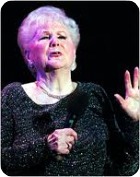
A dozen years ago, I remember being surprised that the passing of Mel Tormé caused barely a ripple. His departure was newsworthy for a day or two, and there were the requisite obits in the New York Times, Wall Street Journal, Washington Postand other noble outlets that still appreciated such seminal, if faded, figures; yet the outpouring seemed pitifully inadequate for one of the greatest jazz vocalists of all time.
But the attention paid to the death of Margaret Whiting, three weeks ago at age 86, made the Tormé trickle seem like a torrent. Granted, Whiting was never as pivotal or prolific a performer as Tormé. Even among the coterie of white songbirds who emerged from the ashes of the big band era as solo stars — Doris Day, Jo Stafford, Peggy Lee, Kay Starr and Dinah Shore — Whiting was the least popular and the least distinctive.
Still, Whiting had a significant impact on the popularization of the Great American Songbook and a decent, even occasionally stellar, career that survived seven decades. The Times, Post and others did, again, rise to the occasion, with solid, if hardly effusive, obits that centered around the same key facts: she was the daughter of popular songwriter Richard Whiting and, after her father’s death, was mentored by Richard’s longtime friend and frequent collaborator Johnny Mercer.
When Mercer founded Capitol Records in 1942, Whiting, then age 16, was among the first artists signed to the label, scoring a significant hit with “That Old Black Magic” when teamed, for her debut recording, with Freddie Slack’s orchestra. A long list of chart hits followed, notably “Moonlight In Vermont” (with an uncredited Les Brown), “Far Away Places,” “It Might As Well Be Spring” and, with Mercer, “Baby, It’s Cold Outside.” She also proved popular among country music fans, scoring a string of hit duets with warbler Jimmy Wakely.
Though never as strong a chart performer as Day, Stafford, Lee or Starr, Whiting remained a decent seller of singles straight through the mid-fifties, when she finally parted ways with Capitol. Like her contemporaries, she recorded her fair share of dreck. But there was plenty of cream among the sour milk, including covers of “Guilty,” “Old Devil Moon,” “A Wonderful Guy,” “My Foolish Heart” and “I’ll Walk Alone” that, if not definitive, are unquestionably fine.
Unlike Lee, and to a lesser extent Stafford and Day, Whiting never quite succeeded as an album artist; a significant contributing factor to her comparative obscurity. Between 1950 and 1990 she released a scant 16 albums (not counting Greatest Hits compilations). None were major sellers. Yet there are precious gems among them. Most have, over the years, surfaced on CD, though by the time of Whiting’s departure, few remained in print. (She has fared better on iTunes, where more than half of her album-length output, plus several excellent compilations, is available).