
Month of celebrating Billie Holiday’s Birthday 7 April - to the incredible & unforgettable #ladyday #BillieHoliday We love you ❤️❤️❤️#queenofjazz #legend #jazz #music #singer #musician #blues #Entrepreneur #composer #fashion #leader #civilrights #American #womeninbusiness #bhm pic.twitter.com/BBQfqaX77f— Billie Holiday Story (@nkbillieholiday) April 17, 2019
Wednesday, April 17, 2019
Billie Holiday
Sunday, October 30, 2016
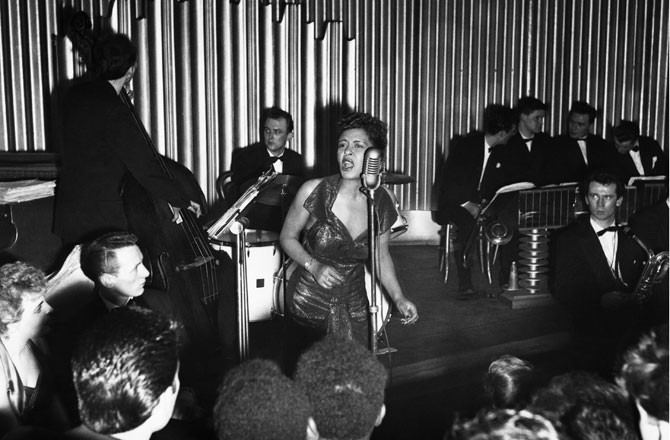
#BillieHoliday, en el escenario durante una presentación
Billie Holiday, en el escenario durante una presentación, 1954 #FelizDomingo #jazz4all #BillieHoliday pic.twitter.com/7L3sukODL3— Fotos Clasicas (@fotoclasica) October 23, 2016
Sunday, July 31, 2016
Billie Holiday
"No 2 people on earth R alike &it's got 2 B that way in music or it isn't music."- Billie Holiday (pic w/Art Tatum) pic.twitter.com/eNdSU2476i— globaljazzqueen (@globaljazzqueen) July 28, 2016
Monday, May 30, 2016
Billie Holiday to Take the Stage – As a Hologram
Hilton-Deutsch Collection / CORBIS
TECHSep 10, 2015 10:20 AM ET
Legendary singer Billie Holiday will return to the New York stage posthumously this year as the Apollo Theater launches hologram performances.
The Apollo, the iconic cradle of jazz located in Harlem, announced it would be the first theater in the United States to feature regular programming by hologram.
3-D Projected Holograms That Shine
The first performance will take place later in the year -- a show by Holiday, one of the greatest influences on generations of jazz and pop singers, who died destitute in 1959.
"The possibilities inherent in this initiative are very exciting, allowing us the ability to show the enduring impact and relevance of artists across time periods and geographic locations," said Jonelle Procope, president and CEO of the Apollo Theater.
Procope said that the Holiday show, made in consultation with her estate, and subsequent performances would also accommodate the growing number of daytime tourists looking to visit the famous theater.
Holiday, who would have turned 100 last April, sang frequently at the Apollo -- one of the few racially integrated theaters at the time -- including an early performance of the seminal protest song "Strange Fruit" about lynchings of African Americans in the US South.
"To be able to bring back epic artists on the historic stage that gave them their debuts is mind-boggling," said Alki David, the Greek-British entrepreneur behind Hologram USA, the company that is partnering with the Apollo.
Holograms record light fields, rather than standard camera images of objects, allowing a three-dimensional presentation.
As the technology has become increasingly sophisticated, holograms have been in growing demand in the concert industry.
read more: http://www.seeker.com/billie-holiday-to-take-the-stage-as-a-hologram-1770231645.html?slide=BuzCSU
Wednesday, January 27, 2016
Billie Holiday Small Band Recordings 1935-1939
by Len Weinstock
There were three phases in Billie Holiday’s career that were so distinct as to give the impression that we were listening to different singers. The first was the carefree swinging Billie who recorded some 120 sides on equal terms with some of the best soloists and improvisers of the 1930, using a natural and relaxed sense of swing. The “second Billie” emerged after she recorded the protest song Strange Fruit, a deeply depressing song of lynching and death sung with much feeling and emotion.

This event immediately altered the course of her career by 180 degrees. She now became a dramatic, serious singer and cut her most famous recordings of heavy, non-swinging material like Gloomy Sunday, God Bless the Child, Am I Blue, I Cover the Waterfront and I got a Right to Sing the Blues. These songs were sung with profound artistry and are considered by many to be her best work, but their value as Jazz is diminished since they were performed with musicians who served only as background accompanists. Finally, in the last sad years of her life in the 1950’s Lady Day’s voice lacked the glow and intonation of former. She sang in a rough, dark style but all the while maintaining her artistry.
Begging forgiveness from Billie, who would have felt I was renaming her “Lady Yesterday”, the “first” Lady Day of the 1930’s, when Swing and Billie were both young, is by far the most important in terms of Jazz history. In 1935 the country was in the midst of the Great Depression. During the previous five years the Jazz recording industry was reduced to only five percent of its 1927 peak. New Orleans/Chicago style was no longer in favor and all the public wanted was to waltz to sweet music. A few Jazz leaders like Duke Ellington, Jimmie Lunceford, Fletcher Henderson and Benny Goodman were trying to make a go of Big Band Swing but things were not going well.
read more: http://www.redhotjazz.com/billieholidayessay.html
Wednesday, April 8, 2015
Billie Holiday: A Singer Beyond Our Understanding

Billie Holiday has become a mythic presence in absentia.
William Gottlieb/Getty Images
APRIL 07, 201511:38 AMMost artists belong to their times, but Billie Holiday, born 100 years ago Tuesday, fits in the present. In a way, she died before her time, just as the country was beginning to talk about race, drugs, feminism and misogyny — all of which converged in her life.
Her death in July 1959 was only briefly noticed in the media. Few would have imagined then that the centennial of her birth would be an occasion for remembrance. But legends are about a state of mind, not a state of being, and some thrive best when they're not in competition with a living person. This is especially true of Holiday.
There was something special about her. Jazz musicians and some fans heard it, and so did a young record producer named John Hammond. He heard an 18-year-old Holiday sing in a small club in April 1933.
"I listened to this girl, and I just couldn't believe my ears that here was a singer who sounded like an instrumentalist, like one of the most advanced instrumentalists there had ever been," Hammond once said. "So I started talking to Billie, and Billie had had a fairly checkered career by then. She'd been in jail and everything. And Billie had already been arrested for prostitution at 14."
In 1935, Hammond began recording her with pianist Teddy Wilson, who put together small jazz groups that included some of the best musicians in New York: Lester Young, Benny Goodman, Ben Webster.
They sold well enough. And by the late 1930s, she had made more than 100 records. But in 1938, in the prime of her career, she ranked only 14th in the annual Down Beat reader poll. Many didn't know her name, even at Harlem's Savoy Ballroom.
In 1939, Holiday heard a song called "Strange Fruit." But the recording label Columbia refused to record it, so she made it for a tiny jazz label. It was a slow, somber, frightening dirge about an unspeakable topic — lynching.
read more: http://www.npr.org/2015/04/07/397877385/billie-holiday-a-singer-beyond-our-understanding
Sunday, January 11, 2015
Billie Holiday and Helen Merrill
Reprinted from http://jazzwax.com


Tessa Souter, whose singing voice I love (go here), sent along a lovely email the other day. Tessa knows I've interviewed Helen Merrill at length (start here) and wanted me to hear something. It was a link to a tape of Helen and Billie Holiday singing You Go to My Head at producer-writer Leonard Feather's apartment in New York in November 1956. This is right around the time of Holiday's Carnegie Hall concert with Chico Hamilton, and months earlier Helen had recorded Dream of You with Gil Evans, one of my favorite vocal albums of the 1950s. This seven-minute-plus audio clip is a fabulous peek into a scene nearly 60 years ago at a party late at night, when two great stylists were getting loose and having fun. Here's You Go to My Head...
Used with permission by Marc Myers
Tuesday, May 20, 2014
Billie Holiday - Moonglow 1952 - Irving Mills
Billie Holiday, born Eleanora Fagan (April 7, 1915 -- July 17, 1959) was an American jazz singer and songwriter. Nicknamed "Lady Day" by her friend and musical partner Lester Young, Holiday had a seminal influence on jazz and pop singing. Her vocal style, strongly inspired by jazz instrumentalists, pioneered a new way of manipulating phrasing and tempo.
"Moonglow", also known as "Moonglow and Love" is a 1933 popular song with music by Will Hudson and Irving Mills and words by Eddie DeLange.
"Moonglow" was first recorded by Joe Venuti and his Orchestra in 1933, with later recordings by Ethel Waters and Benny Goodman and his Orchestra in 1934, and has since become a jazz standard, performed and recorded numerous times by a wide array of musical talents.
A recording of "Moonglow" by the Benny Goodman Quartet is part of the soundtrack to the movie The Aviator. and the movie The Fabulous Baker Boys.
From: https://www.youtube.com/watch?v=9m4PvEP4RpA
Thursday, November 22, 2012
JazzDoc: Billie Holiday
Reprinted from http://jazzwax.com
The jazz life isn't hard. Life is hard, and it just so happens that jazz artists express their ups and downs through music—from swing to blues. Here's another terrific BBC documentary, this time on Billie Holiday, who channeled a lifetime of abuse and self-destruction into art that still touches everyone who hears her recordings...
Used with permission by Marc Myers

Published by 08/02/2012 RosesEternal
Controversial celebrities of the 20th century. Jazz singer Billie Holiday is remembered today for her turbulent personal life as much as for her artistic achievements - addicted to drink, drugs and abusive men, the enduring image is of a tragic victim. However, archive footage and interviews with friends reveal a different Lady Day - a strong woman, determined to satisfy her voracious appetite for sex, drugs and music.
Billie Holiday (born Eleanora Harris April 7, 1915 -- July 17, 1959) was an American jazz singer and songwriter. Nicknamed "Lady Day" by her friend and musical partner Lester Young, Holiday had a seminal influence on jazz and pop singing. Her vocal style, strongly inspired by jazz instrumentalists, pioneered a new way of manipulating phrasing and tempo.
Critic John Bush wrote that Holiday "changed the art of American pop vocals forever." She co-wrote only a few songs, but several of them have become jazz standards, notably "God Bless the Child", "Don't Explain", "Fine and Mellow", and "Lady Sings the Blues". She also became famous for singing "Easy Living", "Good Morning Heartache", and "Strange Fruit", a protest song which became one of her standards and was made famous with her 1939 recording.
Billie Holiday (born Eleanora Harris April 7, 1915 -- July 17, 1959) was an American jazz singer and songwriter. Nicknamed "Lady Day" by her friend and musical partner Lester Young, Holiday had a seminal influence on jazz and pop singing. Her vocal style, strongly inspired by jazz instrumentalists, pioneered a new way of manipulating phrasing and tempo.
Critic John Bush wrote that Holiday "changed the art of American pop vocals forever." She co-wrote only a few songs, but several of them have become jazz standards, notably "God Bless the Child", "Don't Explain", "Fine and Mellow", and "Lady Sings the Blues". She also became famous for singing "Easy Living", "Good Morning Heartache", and "Strange Fruit", a protest song which became one of her standards and was made famous with her 1939 recording.
Monday, November 22, 2010
Billie Holiday: Emotional Power Through Song
Phil Schaap, curator of Jazz at Lincoln Center, says Holiday "speaks to your heart. She catches your ear. She reaches your mind, and she does this with an emotional power that, of course, is genius and is beyond words."
The emotional power of Holiday's vocals comes from the way she sings the melodies. It's about rhythm and phrasing, which Holiday learned from listening to the best.
Holiday was born in Philadelphia in 1915, and was raised in Baltimore. As a girl, she loved music, and her idols were Louis Armstrong and blues singer Bessie Smith.
To hear those 1920s records, Holiday needed a Victrola, and the only place she had access to one was Alice Dean's whorehouse, where as a girl Billie worked scrubbing floors.
"A Victrola was a big deal in those days, and there weren't any parlors around that had one except Alice's," Holiday wrote in in her autobiography, Lady Sings the Blues. "I spent many a wonderful hour there listening to Pops and Bessie. I remember Pops' recording of 'West End Blues' and how it used to gas me. It was the first time I ever heard anybody sing without using any words."
Holiday's real vocal influence is Louis "Pops" Armstrong. She heard his Hot Five vocal numbers, and is clearly an Armstrong-inspired singer. Schaap has studied Armstrong's influence on Billie Holiday closely. He's been demonstrating how Holiday mimics Armstrong's phrasing on his radio shows at Columbia University's WKCR for some 30 years.
"You really have to hear it, is what you have to do," Schaap says. "My telling you that the phrasing over the rhythm that Louis Armstrong has is reprised and utilized in Billie Holiday's concept isn't telling you anything unless you actually go hear their records. I'd like you to hear Louis Armstrong and Billie Holiday take a chorus of 'Yours and Mine.' "
Like a scientist in his laboratory, Schaap, in a WKCR studio, takes Armstrong's and Holiday's versions of the same song, recorded in the same year, 1937. Then he adjusts the turntable pitch controls to speed up Armstrong's vocals and slow down Billie's, so that their voices are closer in pitch.
Schaap says if you listen closely, you can hear how similar the phrasing is — how Holiday literally learned how to sing and swing at the same time from Armstrong. "Well, that was Billie Holiday doing Louis Armstrong," Schaap says. "And I think you can hear it. She gets so much from Pops." In 1949, she actually got to sing with him.
Just as Holiday learned from listening to older singers, generations of younger singers have learned from listening to Holiday — from Frank Sinatra to Shelby Lynne. Singer Joni Mitchell says her two favorite singers are Edith Piaf and Billie Holiday because of the way they use their technical gifts as singers to tell meaningful stories.
"I think I took this from Billie and Piaf, that many of the so-called great singers love their notes more than their text," Mitchell says. "And those women never forgot what they were singing about, so that the note almost played second position to the text. Not that there was anything wrong with the chosen notes. There was still beauty to them, but the emphasis was on telling the story from the heart."
Holiday had plenty of stories to tell, and enough heartache to fill a songbook: years of heroin addiction, a stint in federal prison and a series of abusive relationships with men. She was just 44 years old when she died.
Schaap says too much emphasis has been placed on the tragic aspects of Holiday's life, and not enough on the glorious aspects of her voice.
"She swings and invents," he says. "She innovates. She can compose on the fly, she can make you hear the rhythm section if it's not there, and make them play better if they are. And I think that's it. I think Billie Holiday is the greatest."
From: http://www.npr.org/2010/11/19/131451449/billie-holiday-emotional-power-through-song
Wednesday, July 14, 2010

Sunday, May 30, 2010

Sunday, May 16, 2010
Lady Day: The Many Faces of Billie Holiday
By Ken Dryden
Lady Day: The Many Faces of Billie Holiday, Naxos (2009)
Billie Holiday has long been acknowledged as one of the greatest jazz vocalists of all time. With her extensive catalogue of recordings for several labels, Holiday's music has been readily accessible though relatively little live footage with audio is available.
Lady Day: The Many Faces of Billie Holiday integrates film and video performances, recordings, words from her controversial autobiography (read by actress Ruby Dee) and interviews with artists who played with her (pianist Mal Waldron, trumpeter Buck Clayton and Harry "Sweets" Edison), Milt Gabler (owner of Commodore and a producer at Decca), author Albert Murray and vocalists Carmen McRae and Annie Ross.
Recognized early on as a talent by impresario John Hammond, Holiday gained a foothold at the age of 17 in 1933, debuting on a Benny Goodman recording of the unpromising "Your Mother's Son- in-Law" for Columbia. In 1935, she was recording with bandleader Teddy Wilson and, by the following year, under her own name. Frequently the victim of racism, Holiday left Artie Shaw after a short time because she was omitted from some club dates due to the owners' attitudes, seething in the bus while a white female singer performed pieces associated with her. The one time she landed a movie role, it was as a lowly maid in New Orleans, with subservient demeaning lines.
There are plenty of anecdotes. McRae states that Lester Young addressed Holiday's mother as "Lady Day" and Billie appropriated the nickname. Gabler, who recorded Holiday singing the controversial ballad "Strange Fruit" (which scared Columbia executives), recalled her captivating audiences with it at Café Society Downtown. Waldron, her last accompanist, is shown playing with her late in her career, explaining how much he learned while working with her. The documentary wouldn't be complete without Billie Holiday singing "Billie's Blues" in 1957 on the television program The Sound of Jazz, marking her final reunion with Lester Young.
http://www.allaboutjazz.com/php/article.php?id=36139
Friday, February 5, 2010
Saturday, November 28, 2009
Billie Holiday - Lady in Satin (1958)
Billie Holliday was the best jazz singer of his generation and, in the opinion of his admirers and many critics, the best of all time. Eleanora Holiday was born in Baltimore's black ghetto. His birth certificate was never found, so the accepted date of his birth was that she used to say: 07 de April 1915. His mother, Sadie Fagan (13 years) called Nora and her father, guitarist Clarence Holiday (15 years), were still adolencentes when Billy was born. It was Clarence who called him "Bill" because he thought she was acting like a kid. Billie has everything you could expect in the life of an American girl black and poor.

Walking through the bars of Harlem looking for some money enter the Pod's and Jerry's offering himself as a dancer. A disaster. The pianist sorry asks if she can sing and Billie asks him to play "Trav'lin All Alone" and in a few moments all eyes are glued to her leaving the bar with fifty-seven dollars and a job with fixed salary. Three years after having sung in many places is assisted by producer John Hammond, enter the studio on November 27th, 1933 at the hands of Benny Goodman. In 1935 already seen performing with the orchestra of Duke Ellington in "Symphony in Black, A Rhapsody of Black Life" and start a fruitful partnership with pianist Teddy Wilson, and recorded over eighty songs in six years.
However their experiences with the Big Bands between 1936 and 1938 are bitter. With Count Basie undergoes humiliation how to paint your face with shoe polish as a businessman thought his skin was very clear. With the orchestra of white Artie Shaw is very well treated by the musicians but feel racism on tour Tired of the South such humiliation back to New York and again at the hands of Hammond, gets a good contract at the Cafe Society of Barney Josephson. On January 25, 1937, Billie and saxophonist Lester Young come together for the first time in a studio. Someone wrote that on that day "came a new form of love poetry of the human voice and musical instrument." In four years they recorded about 50 songs, true gems full of swing, taste, creativity and complicity that extended the trumpeter Buck Clayton. Lester called her Lady Day and she nicknamed Prez (President of the tenor sax). Autobiography (1956), written in collaboration with the journalist William Dufty, was called Lady sing the Blues. The title refers more to his unhappy childhood and his involvement with heroin than their actual music.
A fiasco. His career was interspersed with entries in hospitals and prisons as the addiction brought him more trouble. The film Lady Sings the Blues (The case of a star), starring Diana Ross (a bad interpretation), only served to draw public attention on Billie. Diana is not good on paper and not spared criticism. Billie Holiday only won the fame and respect due after his death, held on July 17, 1959, in Philadelphia at age 44 overdose victims and other circustancias depresivas. His voice is a unique interpretations of hundreds of treasures that no longer recorded. The album "Lady In Satin", their best work, hostenda the title referring to the luxurious string arrangements of conductor Ray Ellis orchestration with a plausible voice even more hoarse Billy due to overuse of heroin. Packaged in a contagious harmony, the album has recreations of classics like "I'm A Fool to Want You" (immortalized in the voice of Frank Sinatra) and "The End Of A Love Affair" (Edward Redding). Recorded on 19 and February 21, 1958 for the Columbia Records label and production of Irving Townsend, "Lady In Satin" was only introduced in June 1958. Interestingly the revival of 1997, adds another 04 tracks take killing a little nostalgia.
Songs
01 - I’m a Fool to Want You
02 - For Heaven’s Sake
03 - You Don’t Know What Love Is
04 - I Get Along Wiyhout You Very Well
05 - For All We Know
06 - Violet for Your Furs
07 - You’ve Changed
08 - It’s Easy to Remember
09 - But Beaultiful
10 - Glad to Be Unhappy
11 - I’ll be around
12 - The End of a Love Affair
Musicians:
Billie Holiday - vocals
George Ockner - Violin
David Sawyer - Violoncelo
Janet Putnam - Harpa
Danny Bank - Flaute
Phil Bodner - Flaute
Romeo Penque - Flaute
Mel Davis - Trumpete
J.J. Johnson - Trombone
Urbie Green - Trombone
Tom Mitchell - Trombone
Mal Waldron - Piano
Barry Galbraith - Guitar
Milt Hinton - Acustic Bass
Osie Johnson - Drum
Elise Bretton - Backing Vocals
Miriam Workman - Backing Vocals
http://borboletasdejade.blogspot.com/2009/11/1958-lady-in-satin-billie-holiday.html
Wednesday, September 9, 2009
70 years of 1st recording of "Strange Fruit" by Billie Holiday
The Commodore Records has proved crucial to Billie Holiday, because it was the only one who accepted the risk of record "Strange Fruit" in April 1939, open expression of the struggle of American blacks for civil rights.
The critic Ralph Gleason liked to say that Billie was only happy when he sang. And do not resist the metaphor: "When not singing, she was the living embodiment of the words of" Strange Fruit ", not hung on a tree but the branches of life itself." The song was the strange fruit hanging from the poplar trees south bodies black and the smell of blood in the air.
Strange Fruit
“Southern trees bear strange fruit,
Blood on the leaves and blood at the root,
Black bodies swinging in the southern breeze,
Strange fruit hanging from the poplar trees.
Pastoral scene of the gallant south,
The bulging eyes and the twisted mouth,
Scent of magnolias, sweet and fresh,
Then the sudden smell of burning flesh.
Here is fruit for the crows to pluck,
For the rain to gather, for the wind to suck,
For the sun to rot, for the trees to drop,
Here is a strange and bitter crop”
Although it sounds like a fictional scenario, the verses were written by a Jewish professor and white Bronx, NY, and were inspired by real events.
In 1939, Billie Holiday had a small conflict with her label, Columbia, because I wanted to write a song composed by a man named Lewis Allan (pseudonym of a Jewish professor author of "Strange Fruit"). After much discussion it was decided that the already acclaimed singer obtain a license to write the music to another label, the little Commodore - whose owner, Milt Gabler, began to cry like a baby after she sang Billie him a capella version of the song .
In the same year, in a compact 78 rpm, went "Strange Fruit". The song was a huge success, it was the high point (and final) act for Lady Day All lights were extinguished and only one source of light was lit on the singer, then she spun the sad verses about that scene of horror in south.
And the lyrics are sadder still when we know the song, composed by Abel Meerpool (the Jewish professor who used the pseudonym Lewis Allan), was inspired by a photograph shocking, very shocking.
The picture was taken on 7 April 1930, when a mob lynched Thomas Shipp and Abram Smith, both 19, in Indiana - and barely got a third man, named James Herbert Cameron, 16. The three blacks were accused of robbing and killing a white man and raping his girlfriend. Before they received a trial, were killed and hung by the crowd.
The lynchings were quite common in certain areas of the United States this season - especially black men accused - or not - of crimes against whites. They were also used as a way of intimidating blacks and keep them away from the polls and exercise any of his (few) rights of citizens. After the photographer Lawrence Beitler recorded the scene that inspired the song "Strange Fruit" (and sold thousands of copies of this same photo to 50 cents each), however, they no longer happen. Was the impact of music?
James Cameron escaped alive, wrote the autobiography "Time of Terror: A Survivor's Story" ( "Time of Terror: The Story of a Survivor") and founded the American Museum of the Holocaust Negro, in the words of the institution's own website , aims to educate the public about the injustices suffered by people of black ancestry, while providing visitors an opportunity to rethink their assumptions about race and racism. " It exists today in Milwaukee, Wisconsin, USA.
Text of "TUDO É JAZZ" FESTIVAL (Brazil)
Billie Holiday: The Commodore Master Takes

The Commodore Records were the first only-jazz label in the USA, created in 1938 by the legendary mid-Manhattan record store. In four sessions in the years 1939 and 1944, Billie Holiday sang on 45 complete takes for them. 16 of them have been reunited for the first time on one CD. They belong to her best recordings ever. Her fragile voice and her intonation was not yet affected by her drug and alcohol abuse - she died prematurely in 1959 at the age of 44. She started in 1930 in a small club in Brooklyn.
Lady Day or Lady of Pain, as she was called, recorded her greatest commercial successes with Commodore: Strange Fruit, the song about a victim of lynch-mob, and Fine and Mellow. Besides these two tracks one can find on the CD Yesterdays, I Gotta Right to Sing the Blues - in contrast to its title a very joyful tune -, I Cover the Waterfront and As Time Goes By, a song well-known since Casablanca - of course not sung by Billie Holiday in the film. The Commodore Master Takes is a CD that belongs in all jazz collections.
http://www.cosmopolis.ch/english/cosmo5/billie.htm
Saturday, January 3, 2009
Billie Holiday - Fine and Mellow (1957)
Congregated after many years with the saxophonist Lester Young, the program of the CBS registered a memorable presentation of Billie Holiday (1915-1959) with metal ground. Introduced for Robert Herridge (producing and presenter of the program of the CBS " The Sound of Jazz"), this is perhaps most famous " jazz live program" of the North American TV. Other members of the band:
Coleman Hawkins, Ben Webster, Gerry Mulligan, Roy Eldridge, Doc Cheatham, Vic Dickenson, Danny Barker, Milt Hinton, Badly Waldron.
It's my favourite Billie Holiday interpretation!
Subscribe to:
Posts (Atom)

