Friday, May 27, 2016

Cuong Vu Trio Meets Pat Metheny

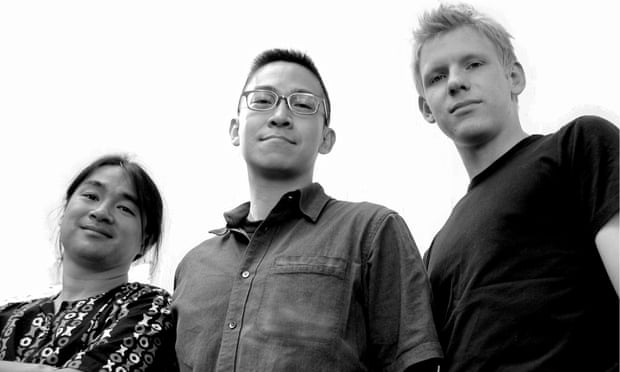
 Cuong Vu Trio. Photograph: William Poor

Vietnamese-American trumpeter and singer Cuong Vu was a key figure in Pat Metheny’s noughties groups, and he credits the guitarist’s Travels album with turning him on to a musical career in the first place. On the second of Nonesuch’s two May releases featuring Metheny the star reverses the roles, guesting with Vu’s long-running trio of Stomu Takeishi on bass and Ted Poor on drums, on five Vu originals plus his own brooding then exultant Telescope and the melodically foxy Tune Blues.

Vu’s group can play like a free-rhythmic avant-rock trio, explore pensive improv worlds in which trumpet lines of a Dave Douglas-like flexibility roll and tumble amid battering drumming and bass-guitar throbs and growls (as in Acid Kiss), adopt an Ornette Coleman-like melodic skip, a warmly brassy tenderness, or build anthemic harmonies to huge, wailing thrashes like the 10-minute Tiny Little Pieces. Metheny enters completely into the exploratory spirit, and gives Vu’s intriguing music a fresh dimension and creative support.

from: https://www.theguardian.com/music/2016/may/26/cuong-vu-trio-meets-pat-metheny-review-nonesuch

Thursday, July 14, 2011

Seattle trumpeter Cuong Vu releases new album


Seattle trumpeter Cuong Vu has a new album, "Shizaru," with the quartet Naked Truth. The music melds jazz improv, electronica and drum'n'bass. Other new CDs this week include Blake Shelton's "Red River Blue"; "If Not Now, When?" by Incubus; and a new selection of Tony Bennett's classic work for the indie label Improv.

Naked Truth, "Shizaru" (RareNoiseRecords)

The brilliant Seattle trumpeter Cuong Vu bridges the gap between jazz improv and the whooshes, whirs and hiccups of electronica. With the quartet Naked Truth (Lorenzo Feliciati, electric guitar and bass; Roy Powell, piano; Pat Mastelotto, drums), he adds drum'n'bass to the mix.

On "Shizaru," ominous beats prowl the deep like sharks, as Powell's acoustic piano gambols over synthesized clouds with twinkling runs and Vu plays the whole sound spectrum, from atmospheric, pushed-air sequences to clarion, unamplified trumpet melodies. The mood occasionally waxes lyrical, but mostly this engaging album takes you to tranceland, where synesthesia easily translates sound into the imagery of a swirling light show. Nice stuff. - Paul de Barros, Seattle Times jazz critic


Tuesday, March 29, 2011

Interview: Trumpeter Cuong Vu on His Approach to Jazz Standards

Trumpeter and composer Cuong Vu has cultivated a mysterious and yet warm lyricism over the course of his extensive career. He released Bound (Omnitone), his first album as a leader, in 1999. Since then he has achieved consistent acclaim for his simple, melodic improvisation, and the way he blends classical, rock, jazz, and electronic music in his instantly identifiable compositions.

Vu’s commitment to playing his own compositions seems to be a necessary part of his artistic statement, as his compositions are so deeply connected to his playing style. However, on his newest album, Leaps of Faith (Origin Records, 2011), which features drummer Ted Poor and bassists Stomu Takeishi and Luke Bergman, Vu shows how works by other composers can apply to his own vision as a performer. I spoke with Vu recently about his treatment of standard jazz repertoire on Leaps of Faith:

Douglas Detrick (DD): Your newest album Leaps of Faith is a decisive turn towards the jazz tradition compared to the previous albums you’ve made as a leader. You start with three standards, perhaps some of the most famous ones of all: “Body and Soul,” “All the Things You Are,” and “My Funny Valentine.” “Leaps of Faith” is based onJohn Coltrane’s “Giant Steps.” Also, you play tunes by George Harrison and Jackson Browne as well as two of your own compositions. How important is repertoire in finding room for your own sound as a musician? In other words, how important is the tune to you?
Cuong Vu (CV): These tunes are part of the body of work that people consider to be played too many times; to be beaten to death. This body of work is also what I (and just about every other student in college) had to learn in college. I had completely stopped playing standards when I got out of college, but when I got a teaching position at the University of Washington, I had to go back and refresh them so that I could demonstrate for my students and to play with them. As I did that, I started to understand them more deeply and some of them really resonated with me.


Live concert with Jesper Lovedale, Jacob Anderskov, Jonas Westergaard, Anders Mogensen and Cuong Vu.