
Born this day in 1925: Legendary #jazz drummer and @MSMnyc alum Max Roach (BM '53), rhythmic innovator, and jazz giant. #RIP #BTD #maxroach pic.twitter.com/DJAGiWNjju— Manhattan S of Music (@MSMnyc) 10 de janeiro de 2017
Tuesday, January 10, 2017
Max Roach
Saturday, January 7, 2017
Max Roach, Count Basie, Shelly Manne with the Jackson 5, Sammy Price and Sugar Pie DeSanto
At JazzWax, Max Roach, Count Basie, Shelly Manne with the Jackson 5, Sammy Price and Sugar Pie DeSanto. https://t.co/54CASZ5rdE pic.twitter.com/mSsWWYDcsY— Marc Myers (@JazzWax) 7 de janeiro de 2017
Wednesday, August 24, 2016
#StanleyTurrentine,#CliffordBrown #MaxRoach
Today’s #CoolSchool w/@chrisphilips ft. Stanley Turrentine & Clifford Brown and Max Roach framed by @BlackEyewear pic.twitter.com/cJGb7bnXMP— Jazz FM (@jazzfm) August 24, 2016
Wednesday, August 3, 2016
Max Roach & Abbey Lincoln
Classic #Jazz Track of the Day: Max Roach & Abbey Lincoln "Lonesome Lover" https://t.co/4ZXuCIjxDO— Curtis Davenport (@curtjazz) August 2, 2016
Sunday, January 10, 2016
Happy Birthday Max Roach, Bee Palmer!

The drummer then teamed with trumpeter Clifford Brown to create one of the greatest combos of that era. After Brown’s tragic death in 1956, Roach continued to innovate, introducing new meters into his music and young talent into his ensembles, In the late 1950s, he formed a small group with trumpeter Booker Little, and took a forceful stand against racism with his LP, Freedom Now Suite. Roach continued to branch out, collaborating with artists outside of music, creating unconventional performing units (solo drum concerts, a double quartet), lecturing internationally and composing for everything from films to string quartets. Roach died in 2007. Listen to the track, “The Drum Also Waltzes” from his LP, Drums Unlimited, here:
Published on Dec 6, 2012
1. The Drum Also Waltzes (Max Roach) 0:00
2. Nommo (Jymie Merritt) 3:33
3. Drums Unlimited (Max Roach) 16:17
4. St. Louis Blues (W.C. Handy) 20:40
5. For Big Sid (Max Roach) 26:03
6."In The Red (A Xmas Carol)" (Max Roach) 29:07
MAX ROACH, drums
JAMES SPAULDING, alto sax
FREDDIE HUBBARD, trumpet
RONNIE MATTHEWS, piano
JYMIE MERRITT, bass
Side 2 track 1 also features RONALD ALEXANDER, soprano sax
this set was Max Roach's only recording as a leader during 1963-67. Three of the six numbers ("Nommo," "St. Louis Blues" and "In the Red") find Roach heading a group that includes trumpeter Freddie Hubbard, altoist James Spaulding, pianist Ronnie Mathews, bassist Jymie Merritt and, on "St. Louis Blues," Roland Alexander on soprano. Their music is essentially advanced hard-bop with a generous amount of space taken up by Roach's drum solos. The other three selections ("The Drum Also Waltzes," "Drums Unlimited" and "For Big Sid") are unaccompanied features for Max Roach and because of the melodic and logically-planned nature of his improvisations, they continually hold on to one's attention.
Copyright disclaimer: immagini, logo, e musica sono di proprietà dei leggittimi proprietari, e il sottoscritto non intende avanzare diritti di alcun genere su di essi .
JOIN QUIZGROUP PARTNER PROGRAM: http://join.quizgroup.com/ .
read more: http://jazzmuseuminharlem.org/today-in-jazz/happy-birthday-max-roach-bee-palmer/
Saturday, April 11, 2015
Max Roach Meets the Backbeat
Reprinted from http://jazzwax.com

Modern jazz survived and flourished in the 1950s largely because many gifted artists didn't sell out. Imagine what would have happened if Clifford Brown, Sonny Rollins, John Coltrane, Miles Davis and Bill Evans decided to open music stores or take jobs at universities rather than tour and record? Or if artists like Max Roach, Jimmy Cleveland, Monk Montgomery and Gigi Gryce had chosen to record R&B singles instead of jazz albums. [Above, Max Roach in 1953]

Actually, the latter hypothetical did take place in 1953. With time to kill between jazz recording sessions in the slow, hot month of August, the jazz musicians listed and others agreed to blow on an R&B date for the Okeh label led by Clifford "King" Solomon, an R&B and jazz tenor saxophonist. They recorded four sides: Li'l Daddee, Square Dance Boogie, Street Walking and But Officer!

Two of the sides appear on a collection called The Okeh Rhythm & Blues Story, 1949-1957—Square Dance Boogie(with a vocal by Ernestine Anderson) and But Officer! (with Gryce on vocal). The first is a medium-tempo boogie with a party atmosphere while the latter has sociopolitical overtones that are relevant today.

Interestingly, a number of the same musicians were on a key Art Farmer session a month before for Prestige (Work of Art, The Little Bandmaster, Mau Mau and Up in Quincy's Room). Here are the musicians on the Farmer date: Art Farmer (tp) Jimmy Cleveland (tb) Oscar Estelle (as,bar) Clifford Solomon (ts) Quincy Jones (p,arr) Monk Montgomery (el-b) and Sonny Johnson (d).
And here are the artists on the Solomon R&B date: Jimmy Cleveland (tb) Clifford Solomon (ts) Oscar Estelle (bar) Wade Legge (p) Monk Montgomery (b) Max Roach (d) and Ernestine Anderson, Gigi Gryce (vcl).

A number of these artists would then go off to Sweden with Lionel Hampton in September: Clifford Brown, Art Farmer, Walter Williams, Quincy Jones (tp) Jimmy Cleveland, Buster Cooper, Al Hayse (tb) Gigi Gryce, Anthony Ortega (as) Clifford Scott, Clifford Solomon (ts) Oscar Estelle (bar) Lionel Hampton (vib,vcl) George Wallington (p) Billy Mackel (g) Monk Montgomery (el-b) Alan Dawson, Curley Hamner (d).

After touring with Hampton, Solomon wound up playing tenor sax on the expanding R&B singles scene in Los Angeles and spent extended periods in the bands of Ike and Tina Turner and Ray Charles, where he was band director. Throughout his career, he also recorded with Charles Brown, Johnny Otis and John Mayall. Solomon died in 2004 at age 73. [Above, Clifford Solomon with Ray Charles in the mid-1970s]
JazzWax note: For more on Clifford Solomon, go here. For more on the Lionel Hampton band in 1953, go here.
JazzWax tracks: You'll find Square Dance Boogie and  But Officer! on The Okeh Rhythm & Blues Story 1949-1957 (Okeh) here.
JazzWax clips: Here's Square Dance Boogie with Ernestine Anderson...
But Officer! on The Okeh Rhythm & Blues Story 1949-1957 (Okeh) here.JazzWax clips: Here's Square Dance Boogie with Ernestine Anderson...
Here's Gigi Gryce singing But Officer!...
And here's the third, Li'l Daddee, the most happening of the tracks. This comes courtesy of Jeff Helgesen via Bob Stumpel, who runs the Ray Charles Video Museum website...
Used with permission by Marc Myers
Wednesday, September 24, 2014
Tuesday, January 28, 2014
Music, records of jazz drummer Max Roach acquired by Library of Congress for preservation
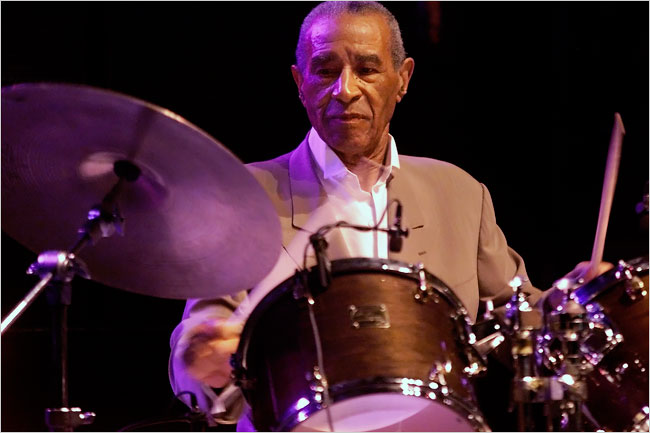
By Brett Zongker, The Associated Press | The Canadian Press - 26 jan 2014
WASHINGTON - Music and recordings from Max Roach, one of the creators of modern jazz drumming, will be preserved at the Library of Congress, curators and his family announced Monday.
Over the past year, the library has been preparing and organizing Roach's personal collection from his body of work over several decades. The collection includes more than 100,000 items, including 80,000 manuscripts and papers, as well as photographs, music manuscripts and hundreds of sound and video recordings.
Roach worked with other such jazz greats as Charlie Parker, Dizzy Gillespie and Thelonious Monk to develop the jazz style known as bebop. And beyond the confines of music, Roach was engaged with the civil rights movement.
"He's a major figure, not just in jazz but in American music," said Larry Appelbaum, a music specialist and jazz curator at the library. "Max represented much more than just a musician or even a composer. He was at the nexus of music, civil rights and black power because he was among that wave of socially conscious musicians."
Roach studied music on many levels. He wrote about his disdain for the label of "jazz." To him, it represented "the worst of working conditions for an artist." He didn't want to be reduced to a stereotype or cliche, curators said.
One of his most important cultural and political works was his "We Insist! Max Roach's Freedom Now Suite" from 1960.
"It's a bold statement," Appelbaum said of the music. "And it really caught the fervour of the times."
The NAACP signed him to a $1,000 contract to perform at a concert as part of the movement leading up to the March on Washington.
Read more: http://ca.news.yahoo.com/music-records-jazz-drummer-max-roach-acquired-library-190151730.html
Saturday, May 22, 2010
The Dozens: Nasheet Waits Selects 12 Classic Max Roach Tracks
by Ted Panken
In an era when drummers consider it a default performance practice to navigate a global template of rhythmic expression, it is important to remember that Max Roach (1924-2007) is the single most important figure in this development.
Just ask the drummers who knew him, as I did a few years back when Downbeat gave me the honor of writing a lengthy obituary. “Before Max, all the drummers, even the great ones like Baby Dodds or Gene Krupa or Chick Webb, approached soloing on the drumset from more of a rudimental and snare drum concept,” said Billy Hart. “Max was the first one to take the rudiments and spread them melodically around the whole drumset—bass drum, tom-tom, snare drum, cymbal.”
“Max was adamant that it was just as important for him to know the form and melody as everybody else,” Kenny Washington added. “He took independence between two hands and two feet to the next level.”
Roach was never content to recreate the past, which he associated with segregation times, and he spent the second half of his career in perpetual forward motion, determinedly bridging stylistic categories. “Max may have used 30 signature things, but he used them in so many different ways,” Jeff “Tain” Watts remarked. “One piece of vocabulary could function as a solo idea, a melody for a solo drum piece. He’d take the same fragment of melodic material and take it out of time, use it like splashing colors on a canvas or whatever, or use it in an avant-garde context, like his duets with Cecil Taylor and Anthony Braxton. That cued me not to be so compartmentalized with certain stuff for soloing and other stuff for something else, but just to use vocabulary—your own vocabulary—to serve many functions.”
Born on Jan. 10, 1924, in Newland, N.C., and raised in Brooklyn, Roach was the first jazz musician to treat the drum set both functionally and as an autonomous instrument of limitless artistic possibility. As a teenager, Roach paid close attention to “drummers who could solo”—Jo Jones, Sid Catlett, Chick Webb, Cozy Cole. Toward the end of his studies at Boys High School, he began riding the subway from Bedford-Stuyvesant to Harlem for late-night sessions at Minton’s Playhouse and Monroe’s uptown House, where the likes of Thelonious Monk, Kenny Clarke and Dizzy Gillespie, all Roach’s elders by several years, explored alternative approaches to the status quo.
By 1942, they had reharmonized blues forms and Tin Pan Alley tunes, changing keys, elasticizing the beat and setting hellfire tempos that discouraged weaker players from taking the bandstand when serious work was taking place. Before World War II ended, the new sound was sufficiently established to have a name—bebop.
Thoroughly conversant in how to push a big band—he hit the road with Benny Carter in 1944 and 1945, and filled in for Sonny Greer with Duke Ellington in early 1942—with four-to-the-floor on the bass drum and tricks with the sticks, Roach made his first record in 1943 with Coleman Hawkins, and played on Hawkins’ ur-bebop 1944 session with Gillespie on which “Woody ’N’ You” debuted. But as Charlie Parker’s primary drummer in 1944 and 1945 and from 1947–49, Roach developed a technique that allowed him to keep pace with and enhance Parker’s ferocious velocities and ingenious rhythmic displacements. His famous polyrhythmic solo on Bud Powell’s “Un Poco Loco” in 1951 foreshadowed things to come in the next decade.
During the early 1950s, Roach studied composition at Manhattan School of Music and co-founded, with Charles Mingus, Debut Records—one of the first musician-run record companies. In 1954, he formed the Max Roach–Clifford Brown Quintet, in which he elaborated his concept of transforming the drum set into what he liked to call the multiple percussion set, treating each component as a unique instrument, while weaving his patterns into an elaborate, kinetic design.
After the death of Brown and pianist Richie Powell in 1956, he battled depression and anger, but continued to lead a succession of bands with saxophonists Sonny Rollins, Hank Mobley, George Coleman, Stanley Turrentine, Eric Dolphy, Clifford Jordan, and Gary Bartz, trumpeters Kenny Dorham, Booker Little, Richard Williams, Freddie Hubbard, and Charles Tolliver, tubist Ray Draper, and pianists Mal Waldron and Stanley Cowell.
Roach also performed as a sideman on such essential ’50s recordings as Thelonious Monk’s Brilliant Corners and Sonny Rollins’ Saxophone Colossus and The Freedom Suite, as well as important dates by Herbie Nichols, J.J. Johnson and Little. He interpolated African and Afro-Caribbean strategies into his flow, incorporated orchestral percussion into his drum set and worked compositionally with odd meters, polyrhythm and drum tonality.
He gave equal weight to both a song’s melodic contour and its beat. “Conversations,” from 1953, was his first recorded drum solo; by the end of the decade, he had developed a body of singular compositions for solo performance built on elemental but difficult-to-execute rudiments upon which he improvised with endless permutations.
He continued to expand his scope through the ’60s. A long-standing member of Bedford-Stuyvesant’s Concord Baptist Church, he incorporated the voice—both the singular instrument of his then-wife, Abbey Lincoln, and also choirs—into his presentation. It was the height of the Civil Rights Movement, and he used his music as a vehicle for struggle, expressing views on the zeitgeist in both the titles of his albums and compositions—“We Insist: The Freedom Now Suite” (commissioned by the NAACP for the approaching centennial of the Emancipation Proclamation), “Garvey’s Ghost,” “It’s Time”—and his approach to performing them.
Roach joined the University of Massachusetts, Amherst faculty in the early ’70s, and seemed to use the post as a platform from which to broaden his expression. In 1971, he joined forces with a cohort of New York-based percussionists to form M’Boom, a cooperative nine-man ensemble that addressed a global array of skin-on-skin and mallet instruments; and in the early ’80s he formed the Max Roach Double Quartet, blending his group, the Max Roach Quartet with the Uptown String Quartet, with his daughter, Maxine Roach.
He recorded with a large choir and with a symphony orchestra. A 1974 duet recording with Abdullah Ibrahim launched a series of extraordinary musical conversations with speculative improvisers Anthony Braxton, Cecil Taylor and Archie Shepp; these sparked subsequent encounters with pianists Connie Crothers and Mal Waldron, and a 1989 meeting with his early mentor Gillespie.
He also reached out to artists representing other musical styles and artistic genres—playing drums for break dancers and turntablists in 1983; collaborating with Amiri Baraka on a musical about Harlem numbers king Bumpy Johnson, and with Sonia Sanchez on drum-freestyle improv; improvising to video images from Kit Fitzgerald, to moves from dancer Bill T. Jones, and to freestyle verse from his nephew, Fred “Fab Five Freddie” Braithwaite, who conjured the epigram, “The man with the fresh approach, Max Roach.”
He scored plays by Shakespeare and Sam Shepard, composed for choreographer Alvin Ailey, and set up transcultural hybrids with a Japanese kodo ensemble, gitano flamenco singers, and an ad hoc gathering of Jewish and Arab percussionists in Israel.
No drummer born after the Baby Boom knew Roach more intimately than Nasheet Waits, whose father, the excellent drummer Frederick Douglas “Freddie” Waits (1940-1989), was an original member of M’Boom. Nasheet attended high school with Roach’s twin daughters, Ayo and Dara, and after Freddie Waits passed away, Roach took Nasheet under his wing, eventually hiring him to play with M’Boom.
”Max always used to say that the drums were treated like the nigger in the band—disrespected in terms of your knowledge of music, your ability to be ‘a real musician.’” Waits says. “Nowadays drummers like Tyshawn Sorey and Marcus Gilmore write as well as anybody else. You have to be to be aware of what’s happening on a lot of levels to be able to play the music. Max may have been the first of his kind like that. He was known as a reader. That’s why he got called to play with Duke Ellington when Sonny Greer was ailing. But then, he said, when he got up to play the chart, there was no chart! So it became instinctual. That’s something that he always stressed to me, personally.
”I had the good fortune of being in his presence quite a bit, on a one-on-one basis, setting up drums and just being around the house. I was starting to get back into playing, and I’d be asking him questions, but his answers were always in a parable, always presented as esoteric knowledge, like trying to get information from a griot and receiving it as a riddle. He always emphasized that the key was to find your own voice, your own path. Everything I’ve heard he plays on always sounds like he’s on the edge, always taking chances, taking it to another level, not satisfied playing the role that drummers traditionally play—and still play.”
Max Roach: For Big Sid
Max Roach-Hassan Ibn Ali: Din-Ka Street
Max Roach-Anthony Braxton: Tropical Forest
M'Boom: Onomatopoeia
Max Roach-Abbey Lincoln: Triptych: Prayer / Protest / Peace
Duke Ellington: Fleurette Africaine
Charlie Parker: Donna Lee
Bud Powell: Un Poco Loco
Max Roach: Garvey's Ghost
Max Roach-Clifford Brown: Love Is A Many Splendored Thing
Max Roach: Variation on a Familiar Theme
Max Roach-Dollar Brand: Streams of Consciousness
http://www.jazz.com/dozens/the-dozens-nasheet-waits-selects-classic-max-roach-tracks
Subscribe to:
Posts (Atom)

