
We all have music in us your heartbeat is your drum, your voice is your sound & music is supposed to put you in tune with nature #RandyWeston Join us on 6/9 to Celebrate #RandyWeston at @kencen w/ @realTKBlue @vijayiyer @MarcCaryMusic + https://t.co/E6TlSXPmo9 #MotivationalMonday pic.twitter.com/L22FlQjFJL— DC Jazz Festival (@dcjazzfest) May 13, 2019
Wednesday, May 15, 2019
#RandyWeston
Sunday, September 11, 2016
#JimmyHeath #RandyWeston & more ...
Live now: Jimmy Heath, Randy Weston, & more celebrate record producer Orrin Keepnews! Watch: https://t.co/XvdVTTxaE4 pic.twitter.com/6QsFS3KtDp— JazzatLincolnCenter (@jazzdotorg) September 8, 2016
Friday, July 15, 2016
RandyWeston
«Pour moi, la musique est un moment de corps à corps» https://t.co/5ZI4LtsMO4 #RandyWeston pic.twitter.com/30oWXxBWUU— Jazz Music News (@mhq_jazz) July 14, 2016
Thursday, December 3, 2015
Randy Weston
Randy Weston: A Giant of Jazz, a Giant of a Man
Posted: 12/02/2015 1:14 pm
Updated: 12/02/2015 1:59 pm
Jazz is, like the Blues, one of the music genres that is purely and genetically Classical American music in the sense of "classical" denoting "of a form regarded as representing an exemplary standard, traditional and long-established in form or style". Jazz is pure American music. Its creators are Africans who were brought to the Americas so that Jazz's umbilical cord and its genesis are fused with while, at the same time, being parallel to the history of African people in America, "African-Americans" in today's parlance.
One way we get knowledge of Jazz's history and its contributions to our American culture and memory is through the series as those presented by public television such as the Public Broadcasting System. One of these Jazz monuments to our common memory is "Jazz, A History of America's Music" by Ken Burns.
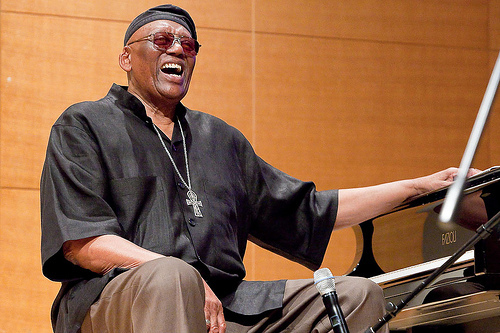
One of the still standing giants of this music genre is Randy Weston, a very active and living legend at 89 years old, a giant of Jazz and also a giant of a man (almost 8 feet tall). Everything about Randy is giant, huge (including a booming voice and laughter) that, as the late Jazz critic Stanley Crouch wrote, "Weston has the biggest sound of any jazz pianist since Ellington and Monk, as well as the richest most inventive beat..." Langston Hughes commented: "When Randy Weston plays, a combination of strength and gentleness virility and velvet emerges from the keys in an ebb and flow of sound seemingly as natural as the waves of the sea." And, as we wrote in the "Liner Notes" to his 2006 Zep Tepi release, "With age, like African Palm Wine, his music has grown tastier, deeper, sweeter, greater, soul-pleasing, spirit-uplifting, and body-regenerating at the loftiest level".
One of the still standing giants of this music genre is Randy Weston, a very active and living legend at 89 years old, a giant of Jazz and also a giant of a man (almost 8 feet tall). Everything about Randy is giant, huge (including a booming voice and laughter) that, as the late Jazz critic Stanley Crouch wrote, "Weston has the biggest sound of any jazz pianist since Ellington and Monk, as well as the richest most inventive beat..." Langston Hughes commented: "When Randy Weston plays, a combination of strength and gentleness virility and velvet emerges from the keys in an ebb and flow of sound seemingly as natural as the waves of the sea." And, as we wrote in the "Liner Notes" to his 2006 Zep Tepi release, "With age, like African Palm Wine, his music has grown tastier, deeper, sweeter, greater, soul-pleasing, spirit-uplifting, and body-regenerating at the loftiest level".
read more: http://www.huffingtonpost.com/yaalengi-ngemi/randy-weston-a-giant-of-j_b_8683730.html
Monday, October 7, 2013
Randy Weston: Hi-Fly, Little Niles and Africa
More observant listeners are impressed with Randy’s strong, virile attack, his steady beat and his melodic imagination; both in improvising and composing he seemed to show the influence of Thelonious Monk.
- Leonard Feather, Jazz author and critic
“I expect that in the decade and more ahead, Randy will become as recognized for his compositions as for his playing.”
- Nat Hentoff, Jazz author and critic, writing in 1957
Weston's '50s recordings for Riverside Morocco Rabat
- Gary Giddins, Jazz author and critic
“You can have it. It’s not music that’s going to get any air time on my show.”
The speaker was a family friend who hosted a very successful AM radio program that primarily featured the music of popular singers like Frank Sinatra, Johnny Mathis, Vic Damone, Rosemary Clooney or Patti Page; singers who sang the commercial hits of the day as arranged by Nelson Riddle, Billy May, Henry Mancini and a whole host of other, orchestrators.
Given the sterling reputation of his radio show, many distributors sent him sample copies of long-playing records, today known as “vinyl,” many of which contained music that was superfluous to his program.
His offer of a gift had to do with an LP that I was holding in my hands with music by the Randy Weston Trio and the Lem Winchester Quartet that was recorded one afternoon [July 5th] during the 1958 Newport Jazz Festival.


Entitled New Faces at Newport, the album was on the obscure Metro Jazz label [E1005].
I had no idea who [pianist] Weston or [vibraphonist] Winchester were, but hey, free is free, especially at a time in my life when popping $5 bucks for a Jazz record was still a lot of money.
I was familiar with the rhythm section of Ray Santisi on piano, John Neves on bass and Jimmy Zitano who accompanied Winchester from a Herb Pomeroy’s Boston-based big band LP that I had in my “collection” so I first played Lem’s side of the LP leaving the tracks by Weston for a later listen.
The time allotted to the four tracks by Randy on this album is largely taken up by a long drum solo by G.T. Hogan on an “excerpt” from Weston’s Bantu Suite. I didn’t find the remainder of that suite until many years later, but the title was a portent of things to come as Randy was to become a major exponent and interpreter of African music for much of his later career.
When I did get around to a close listening of the other tracks by Randy Weston on that Metro Jazz LP, what struck me – to the point of fascination – was Randy’s original composition Hi-Fly. Melodically, it is little more than a ditty based on a repetition of fifths, but I found myself whistling or humming it for days.
I was also taken by Weston’s minimalist approach to piano playing. He seemed to frame the tune with thoughtful improvisations much like Jimmy Rowles or Duke Jordan or John Lewis, but his style was somehow very distinctive.
As Dick Katz describes it in his essay on Jazz pianists from the 1940’s and 1950’s in Bill Kirchner, ed., The Oxford
“Like Thelonious Monk’s, Randy Weston’s piano style defies outright imitation. He takes elements of Monk, Ellington, and a little Bud Powell, and ingeniously melds them with aspects of his own intense interest in African cultures, particularly those of Morocco Nigeria Niles
Read more: http://jazzprofiles.blogspot.com.br
Monday, September 19, 2011
Randy Weston African Rhythms,

The Jazz Ministry at Saint Peter’s Church announces Randy Weston African
Rhythms, NEA Jazz Master, Composer, and Pianist Honoree at All Nite Soul 2011 Sunday, October 9th.
Saturday, May 21, 2011
Jazz Journalists Association Announces Musical LineUp for Awards
Pianist Randy Weston headlines the artist lineup and tickets are now on sale at www.JJAJazzAwards.org for the 15th annual Jazz Journalists Association Jazz Awards gala, to be held on Saturday, June 11, from 1 pm to 5 pm EDT at City Winery, 155 Varick St. at Vandam in New York City .
Besides Weston, trumpeter Wallace Roney ' s sextet, Canadian flutist/soprano saxophonistJane Bunnett with Cuban-born pianist Hilario Duran and special guest Candido on congas, singer Gregory Porter (a nominee for the JJA ' s Male Vocalist of the Year Award) and the Hammer Klavier Trio from Hamburg will perform at the event. The JJA gala, a fundraiser for the non-profit professional organization that promotes coverage of jazz in all media, will also feature announcements and presentations of the Awards to winners, and introductions of "Jazz Heroes" honored for extra-musical jazz activism in locales across the U.S. (in order to highlight the decentralized aspect of jazz activism, the JJA is not inducting "A Team" jazz activists this year). City Winery refreshments and beverages, as well as Brother Thelonious Ale and Celebrity Jazz cognac will be served.
The Jazz Awards is being produced as live streaming video, viewable online (and later archived) at JJAJazzAwards.org. Free satellite parties have been convened to watch the Awards in Berkeley, Boston, Nashville, Phoenix, Portland OR, Seattle and Washington, D.C, among other sites.
The general public may purchase tickets to the Awards gala in New York for $150. Ticket reservations, the list of all nominees for 2011 JJA Jazz Awards, details about the satellite parties and videos of the performers are also available at JJAJazzAwards.org.
Jazz Awards headliner Randy Weston, robust at 85 and a recently named Guggenheim Fellow, is a nominee for the JJA ' s Best Book of the Year Award for his autobiography African Rhythms ("arranged" by former JJA vice president Willard Jenkins). Weston ' s performance and that of singer Gregory Porter, whose album Water was nominated for a Grammy as vocal jazz cd of the year, are being supported by Motema Records. Acclaimed trumpeter Wallace Roney and his band with his brother Antoine and Arnold Lee on saxophones is being supported by HighNote/Savant Records.
Pianist Hilario Duran, born in Cuba and residing in Canada, has been nominated for two Juno Awards for his 2010 album Motion, hailed as #1 of the year by the Latin Jazz Network; soprano saxophonist/flutist Jane Bunnett, a multiple Juno winner who led her Spirits of Havana ensemble at the 2009 JJA Jazz Awards, has been Duran ' s guest artist on tour with a 13-pieceLatin Jazz band. Their performance is supported by Alma Records; master conguero Candido Camero, who joins them, was voted Percussionist of the Year by the JJA in 2009. The Hammer Klavier Trio, presented by Jan Matthies Management, is the subject of a JJA-nominated Short Form Video of the Year, and appears at the Jazz Awards as part of its debut American tour.
The JJA Jazz Awards is the only broad-based, independent, international celebration of jazz excellence. Begun in 1997 as a collaboration between the Jazz Journalists Association and Michael Dorf (then executive director of the Knitting Factory, now Founder and CEO of City Winery), it has been produced annually since 1999 by the JJA as part of its effort to increase awareness of jazz worldwide through writing, photography, audio/video and new media productions.
JJA Jazz Awards are presented 39 categories encompassing jazz music, presentation and documentation. The JJA ' s "Jazz Heroes" are activists, advocates, altruists, aiders and abettors of jazz who have had significant impact on their immediate locales. The 2011 "Jazz Heroes" are:
● Omrao Brown, managing partner of Bohemian Caverns, who has helped stimulate new jazz activities in Washington , D.C.
● Peggy Cafritz, supporting founder of the Duke Ellington School of the Arts in Washington , D.C.
● John Gilbreath, executive director of Earshot Jazz, Seattle.
● Dr. Maiterya Padukone, dentist affiliated with the Jazz Foundation of America, treating musicians in New York City .
● Don Z. Miller, jazz impresario of Arizona , Mexico and Europe .
● Ed Reed, 82-year-old singer and substance abuse counselor, Richmond , California .
● Mike Reed, drummer, bandleader, music series and festival presenter, Chicago.
● Roger Spencer and Lori Mechem, directors of the Nashville Jazz Workshop, Nashville .
● Elynor Walcott and her sons, proprietors of Wally ' s Jazz Café, longtime venue for youthful and emerging jazz in Boston .
The Jazz Awards gala raises funds for JJA educational efforts and activities aimed at developing new audiences for jazz. These include the eyeJAZZ video training program, audience enrichment programs at jazz festivals and educational institutions, initiatives using social media to activate under-addressed segments of the potential jazz audience and establishment of online platforms for jazz journalists.
To see all nominees for the 2010 JJA Jazz Awards and to purchase tickets for the gala, go towww.JJAJazzAwards.org. For further information, contact President@JazzJournalists.org.
Friday, June 25, 2010
Randy Weston On Piano Jazz
by Grant Jackson
Pianist Randy Weston recently returned to Piano Jazz for a new session with host Marian McPartland. Weston got his start playing with Eddie "Cleanhead" Vinson and Kenny Dorham in the late 1940s and '50s, and won New Star Pianist in the 1955 Downbeat poll. By the end of that decade, Weston was inspired by the burgeoning civil rights movement in the U.S. and the independence movement among African nations.
Weston incorporated African music into his compositions, and at the end of a 1967 U.S. cultural delegation's tour of Africa, decided to settle in Tangier, Morocco, where the Brooklyn native operated his African Rhythms club for seven years. In this session, Weston performs a set of tunes reminiscent of his African experience, as well as one of his earliest influences, Thelonious Monk.
Weston kicks off the session with his tribute to Monk, "A Ballad for T.," which quotes a few bars from Monk's tunes. As a young man, Weston had the chance to spend time with Monk, and before ever visiting Africa, he'd found connections to the continent in Monk's music.
"My good friend, the bassist Ahmad Abdul-Malik's people were from the Sudan, and he played the oud, which has this thing of playing notes between the notes," Weston says. "I couldn't get that sound on the piano. But when I heard Thelonious Monk play, I heard this same magic on the piano; even his way of swinging had that same element."
"African Lady," part of Weston's 1960 suite Uhuru Africa, incorporates many African elements and contains a lyric penned by Langston Hughes. Weston's solo piano take evokes the African continent: elegant, lush landscapes as well as complex, bustling cities and windswept open country. Fifty years on, the piece still sounds fresh and evocative of the cradle of humankind.
Weston focuses on the African city closest to his heart with "Tanjah" (Arabic for Tangier).
"It's an incredible city," Weston says. "I had a house overlooking the Mediterranean, and I could see Spain on a clear day."
The tune opens with a repetitive, driving bass line and a pounding, Monk-like melody that gives way to a marching rhythm, with an Eastern-flavored figure played by the right hand. It conjures the melting pot of cultures in the city's crowded streets — the sounds and smells — and the wild, dusty landscape beyond the walls. "Little Niles" follows; it's a tune written for Weston's son, later known as Azzedine. This composition also refers to Monk in its playful bounce and angular clusters, but with a bit more drama.
Weston finds a deep connection between the organic character of jazz and the natural world.
"This music is totally in touch with Mother Nature. Mother Nature is always improvising — it's cold, it's hot, it rains, it snows... this music is in touch with the universe." McPartland plays her portrait of Randy Weston, and she has no trouble evoking the towering personality of the 6'8" pianist. Herself no stranger to leaning on the pedals, McPartland sprinkles her trademark sparkle among deep, expansive chords.
The session closes with Weston's composition, "Ifrane," an epic tune from the 1972 album Blue Moses recorded with bassist Ron Carter, drummer Billy Cobham and an ensemble including Grover Washington and Freddie Hubbard. Weston was inspired to write the tune after visiting a ski village in the Atlas Mountains. He plays colorful notes over a monolithic bass line, and the twinkling notes ascend the keyboard to end this week's session high on a North African mountaintop.
Originally recorded May 12, 2009. Originally broadcast June 22, 2010.
http://www.npr.org/templates/story/story.php?storyId=128110974&ft=1&f=1039
Subscribe to:
Posts (Atom)

