
St. Elmo Sylvester Hope was born in New York on June 27, 1923. He began piano studies at age seven and, by 1938, was winning medals for solo recitals. He and his boyhood friend, Bud Powell, spent time together listening to Bach, and playing for each other. When he came back to New York after Army service in 1943 Hope, who described himself as "self-taught as a pianist and composer," gained experience in taxi dance hall relief bands, where he would change the chords in the stock arrangements after the first chorus; and at small clubs in the Bronx, Greenwich Village and Coney island."At the very instant when Monk and Powell had lost some of their creative fire, Elmo Hope . . . seemed destined to assume a place among the very finest pianists in jazz history, but he had little chance to build on his achievements. Instead, he left only a few glimpses with which we may conjure what a full and secure career might have offered." - David H. Rosenthal
After a short stint with Snub Mosely's combo he joined Joe Morris in 1948, working with him into 1951. That band recorded for Atlantic, and there was also a date in 1949 for Decca where the pianist is listed in Jepsen's discography as Elmore Sylvester. However, the only numbers which would have given an indication of Elmo's jazz abilities remain unreleased to this day.
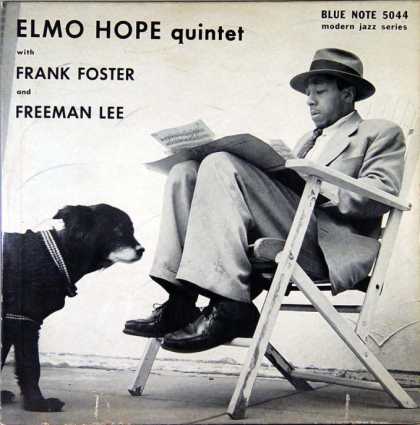
Almost a year later, May 9, 1954, Hope and Heath returned to Rudy Van Gelder's Hackensack studio along with Art Blakey rounding out the rhythm section, and the horns of tenor saxophonist Frank Foster and Freeman Lee forming a front line.
After the quintet date, Hope was a sideman for another Lou Donaldson-led Blue Note session in August; and a Sonny Rollins date for Prestige in that same month. In 1955 he began a series of dates for Prestige beginning with a trio outing in June and continuing with a quartet (featuring Foster) in October. In January 1956 he did Lights Out under Jackie McLean's leadership, and in June was a sideman on Informal Jazz, later reissued by Prestige as Two Tenors, featuring John Coltrane and Hank Mobley.
In April he was supposed to be the pianist on a Gene Ammons session later released as The Happy Blues, but after arriving at the Prestige offices on West 50th Street ahead of time, he left and had to be replaced by Duke Jordan before the band motored to New Jersey and Van Gelder's studio. That was a Friday Afternoon. The following Tuesday, Elmo showed up, explaining he had gone to "visit a sick aunt" at Roosevelt Hospital about nine blocks away and had lost track of the time. It was obvious that Hope was caught up in the pursuit of the "horse" that many musicians were riding at the time.
In 1957 he worked with the groups of two diverse trumpeters, Dud Bascomb and Chet Baker. With the latter he traveled to California and decided to remain in Los Angeles. While there he worked with Lionel Hampton at the Moulin Rouge but his main affiliation was with tenor saxophonist Harold Land, with whom he gigged and recorded The Fox in 1959. He also did his own trio LP in '59. In 1958 he met his wife-to-be Bertha, also a pianist, and married her in 1960.

Although he did not work a lot in Los Angeles, it was evident from his playing and writing in this period that Hope was in good health and a productive frame of mind. Nevertheless he felt stifled. In an interview with John Tynan, West Coast editor of Down Beat (Published in the January 5, 1961 issue) Elmo said: "The weather is great, and there are a few people I dig. But this is no place to learn anything. If they (young jazz players) want to learn, let them go back to New York-both for inspiration and brotherly love. They'll hear more things happening . . ."
When Orrin Keepnews of Riverside Records visited LA he encouraged Hope and Elmo decided to return to New York. In June of '61 he recorded Homecoming for Riverside with old friends Foster, Heath, and Philly Joe Jones among the participants. In November he did a solo album for Riverside, in which he was joined on three numbers by Bertha Hope at a second piano.
There were also two trio dates in 1961 for Joe Davis' Celebrity and Beacon labels in which Elmo reprised nine of the songs he had done for Blue Note in 1953 and '54 under his own leadership, plus two others he had done with Donaldson.
His next recording was not until 1963 and, by its very title and context, Jazz From Riker's Island, indicated that Hope was again involved with his heroin habit. He had not been visible on the New York club scene in any prominent way and this was also the case during the next few years. It was commonly believed that the 1963 album had been his last as a leader but in May and August of 1966 he did two trio sessions for Herb Abramson's Festival Records (Abramson must have known him from the Joe Morris days since he was one of the founders of Atlantic Records) that posthumously found their way into print on the Inner City label in 1977.
In 1967 Elmo was hospitalized with pneumonia for several weeks and while recuperating, succumbed to an apparent heart attack. I had just come back to Down Beat for a second tour of duty as New York editor. The first news story I was asked to cover was this one.
At the funeral home the recording of Elmo's "Monique" played constantly as a bittersweet reminder of what a musician he was and what might have been. As the coffin was about to be closed, his aged father ran toward it sobbing, "My son! My son!" It was a heart-wrenching moment that remains fresh in my mind more than twenty years later. Elmo died on May 19 but hope had been deceased for some time.
From: http://hardbop.tripod.com/ehope.html--IRA GITLER, from the liner notes, Elmo Hope Trio & Quintet

