
How Charles Lloyd stays marvelous https://t.co/FOTYyMzkTV #jazz— Jazz Beyond Jazz (@jazzbeyondjazz) 26 de abril de 2017
Friday, June 16, 2017
How Charles Lloyd stays
Monday, March 13, 2017
#KeithJarrett Plays Soprano Saxophone
#KeithJarrett #CharlesLloyd #sax— Peter McConnell (@jazzstagenet) 10 de março de 2017
Keith Jarrett Plays Soprano Saxophone with Charles Lloyd Quartet (1968)
Keith... https://t.co/fQhnH6z3pf
Monday, June 6, 2016
SANGAM: Charles Lloyd, Zakir Hussain, Eric Harland


The music of NEA Jazz Master, Charles Lloyd, is steeped in jazz traditions ( some of those he helped to create ), but the saxophonist has transcended musical categories since his landmark 1966 album "Forest Flower, Live at Monterey,” an event where jazz mingled with young rock audiences for the first time. His project with Grammy winning Zakir Hussain, and the extraordinary drum master, Eric Harland, is a journey through the musical influences in his life - one can hear the R&B sound of his hometown, Memphis, mixed with his love for world music. Sangam is filled with deeply searching improvisations. The group demonstrates that sometimes jazz works wonders when it is mixed with music from other cultures.
“Mr. Lloyd is the rare jazz artists whose every appearance qualifies as an event.”
— The New York Times
“Zakir Hussain, the world’s greatest living tabla player.”
— The Telegraph
“Eric Harland, an entrenched titan on his instrument.”
— The Buffalo News
Part of the Blue Note Jazz Festival.
from:http://thetownhall.org/event/sangam
Wednesday, November 12, 2014
Interview: Jazz great Charles Lloyd
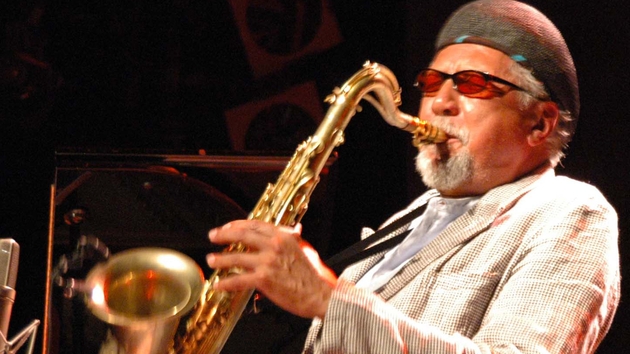
Monday 03 Nov 2014
Harry Guerin: As a child in the South, did you feel music was your calling from the first time you picked up an instrument?
Charles Lloyd: I first heard the saxophone in a parade when I was three-years-old and a light went off. I said, 'That is what I want to do'. I had to wait until I was nine to actually get a saxophone and start playing. My mother had a hard time taking it away from me - I even tried to play it in the bathtub.
Charles Lloyd: I first heard the saxophone in a parade when I was three-years-old and a light went off. I said, 'That is what I want to do'. I had to wait until I was nine to actually get a saxophone and start playing. My mother had a hard time taking it away from me - I even tried to play it in the bathtub.
What memories from your early years playing are you drawn back to again and again?
There are many volumes of memories. Transformative ones start from my early days with Chico [Hamilton, drummer and bandleader] and Cannonball [Adderley, alto saxophonist and bandleader] - I came through San Francisco a lot performing at the Jazz Workshop and the El Matador. After the 1966 [Charles Lloyd] quartet concert in Monterey, we had a gig for a week at the El Matador. There was a theatrical group The Committee - very outside, zany guys like [John] Belushi and Second City in Chicago - they had their own theatre up the street on Broadway. They would stop in each night after their performance had closed. One of the members, Morgan Upton, came to me and said, 'We're not jazz buffs but we sure like coming to hear you guys play every night'.
He suggested that I should be playing at the Fillmore where there were lots of young people. I asked him who played there and he said, 'Muddy Waters'. I said, 'McKinley Morganfield, I know him'. He introduced me to [promoter] Bill Graham who invited me to his emporium. Word began to spread about us in non traditional jazz quarters and rock groups wanted to be on bills with us because they loved the freedom we had with improvised music.
There was a disc jockey, Tom Donohue, who used to play our music a lot on FM radio. Barriers were coming down and you could hear our music along with Ravi Shankar, The Grateful Dead, Paul Butterfield, Quicksilver Messenger [Service], Janis Joplin, Jefferson Airplane, Jimi Hendrix, the Cream, Howlin' Wolf…
There are many volumes of memories. Transformative ones start from my early days with Chico [Hamilton, drummer and bandleader] and Cannonball [Adderley, alto saxophonist and bandleader] - I came through San Francisco a lot performing at the Jazz Workshop and the El Matador. After the 1966 [Charles Lloyd] quartet concert in Monterey, we had a gig for a week at the El Matador. There was a theatrical group The Committee - very outside, zany guys like [John] Belushi and Second City in Chicago - they had their own theatre up the street on Broadway. They would stop in each night after their performance had closed. One of the members, Morgan Upton, came to me and said, 'We're not jazz buffs but we sure like coming to hear you guys play every night'.
He suggested that I should be playing at the Fillmore where there were lots of young people. I asked him who played there and he said, 'Muddy Waters'. I said, 'McKinley Morganfield, I know him'. He introduced me to [promoter] Bill Graham who invited me to his emporium. Word began to spread about us in non traditional jazz quarters and rock groups wanted to be on bills with us because they loved the freedom we had with improvised music.
There was a disc jockey, Tom Donohue, who used to play our music a lot on FM radio. Barriers were coming down and you could hear our music along with Ravi Shankar, The Grateful Dead, Paul Butterfield, Quicksilver Messenger [Service], Janis Joplin, Jefferson Airplane, Jimi Hendrix, the Cream, Howlin' Wolf…
Santana told me that he used to go hear me at the Fillmore as a teenager and sit in the front row and shout 'Free the people Charles, free the people!'. This was a time when people's attitudes began to change and the music was becoming more open - the social scene was becoming freer and we were seeking to realise very high ideals.
read more: http://www.rte.ie/ten/news/2014/1103/656563-interview-jazz-saxophonist-charles-lloyd/
Monday, March 25, 2013
Charles Lloyd, Nicole Mitchell, Steve Coleman among top jazz releases
By Bret Saunders, Special to The Denver Post
There's so much accomplished new recorded music stacking up that I thought this relative breather between concerts would be a good time to get some of it out of my system and perhaps into yours.
Mostly Other People Do The Killinghas, over the decade since their formation, gelled into one of the premier jazz ensembles. Their CD cover art has perhaps received as much attention as the music itself, with the quartet's members re-creating classic LP shots from the likes of Roy Haynes and Ornette Coleman.
On the new "Slippery Rock" (Hot Cup) they present themselves as members of a slick '80s-era pop jazz ensemble a la Spyro Gyra (who will be in Parker

Lee Konitz will play at Dazzle on Sunday. (Associated Press)
Charles Lloydcontinues his seemingly endless winning streak with"Hagar's Song" (ECM) a more reflective set of duetswith pianist Jason Moran. Lloyd utilizes his arsenal of flutes and saxes to engage in soothing dialogue with pianist Moran, who has proven himself to be an empathic presence. It's a lovely hour, with the elder statesman reflecting on history (of jazz and himself.) Particularly effective are the meditative "Hagar Suite," the blues-inflected cover of Duke Ellington's "Mood Indigo," and the CD's delicate coda, a cover of (former Lloyd associates) The Beach Boys' "God Only Knows."
The notion of "jazz flute" has probably been relegated to Ron "Anchorman" Burgundy in recent years, and that's too bad, because, like Lloyd, there are some fine practitioners on the instrument,includingNicole Mitchell. Her quartet Ice Crystal has a spirited new CD, "Aquarius," (Delmark) that extends back into Eric Dolphy and Rahsaan Roland Kirk territory. The idea behind this project is to contrast her flute with vibraphonist Jason Adasiewicz, hence the aural "ice crystals." The sonic combination is intriguing, and even if you're not disposed to love the flute as a lead instrument, there are plenty of exciting ideas being explored here. Of the handful of Mitchell's releases I've heard, this one is the most appealing.
Read more:Charles Lloyd, Nicole Mitchell, Steve Coleman among top jazz releases - The Denver Posthttp://www.denverpost.com/music/ci_22843696/charles-lloyd-nicole-mitchell-steve-coleman-among-top?source=rss#ixzz2ObHtCw00
Wednesday, September 14, 2011
Charles Lloyd and Maria Farantouri - Athens Concert
For Charles Lloyd and Maria Farantouri, the hope was to create a musical bridge between the old world and the new. The esteemed saxophonist and Greece’s “voice of resistance” met at the foot of the Acropolis to turn this dream into a reality. The resulting Athens Concert turned out to be a spectacular event, a melding of two cultures that exceeded all expectations.
The musicians involved include Lloyd’s outstanding quartet, which features Eric Harland (drums), Reuben Rogers (double-bass), and Jason Moran (piano), in addition to Lloyd’s own tenor sax, flute, and tarogato. Supplementing the lineup we have Socratis Sinopoulos (lyra), and a second piano played by Takis Farazis. It may have been the setting, or the addition of another piano, but Jason Moran was positively inspired this night.
In many ways, the show belongs to Maria Farantouri, though. Her voice is a stunning instrument, filled with the type of raw emotion one rarely hears anymore. Charles Lloyd compares her expressiveness to that of Lady Day (Billie Holiday) herself.
The “musical marriage” is best achieved during the three-part “Greek Suite,” which accounts for a large portion of Athens Concert. It is obvious that a great deal of care went into selecting the music for the suite. Utilizing sources ranging from ancient Byzantine hymns, to traditionals from the Black Sea and other regions, to contemporary compositions from Mikis Theodorakis, and Lina Nikolakopoulou and Nikos Kypourgos, the piece is majestic in scope.
The concert showcases some of Charles Lloyd’s most famous jazz music as well. The audience is clearly appreciative of his classic “Dream Weaver,” which follows the introductory “Kratissa ti zoi mou” (“I Kept Hold of My Life“) in the program. The subsequent “Blow Wind” is also a crowd favorite, and both provide opportunities for some notable piano work from Jason Moran.
The evening ends with a traditional piece from the Epirus region, “Yanni mou” (“My Yanni”). Second pianist Takis Farazis joins the group for a finale in which all of the various musical elements of the night come into play.
It must have been a spectacular sight, but for those of us who were not there, the two-disc Athens Concert will have to suffice. It is filled with not only beautiful, but sometimes challenging music and is a mighty testimonial to the strength of a dream shared by Charles Lloyd and Maria Farantouri.
Read more: http://blogcritics.org/music/article/music-review-charles-lloyd-and-maria/#ixzz1XtXDIVrG
Sunday, September 5, 2010
Tenor/soprano saxophonist/flutist/composer/ bandleader Charles Lloyd represents to many the ideal crossover artist

Tenor/soprano saxophonist/flutist/composer/ bandleader Charles Lloyd represents to many the ideal crossover artist, having early on combined elements of rock with jazz.
Lloyd was born in Memphis, Tenn., on March 15, 1938. His saxophone playing started when he was 10 years old, starting as a self-taught musician and later going with teachers. B.B. King and Bobby Bland were early assignments, as were other r&b bands as a teenaged alto player. In the mid '50s Lloyd was enrolled at the University of Southern California, studying music composition. Out of school with a degree, Lloyd was a music teacher until he joined Chico Hamilton in 1961. With Hamilton he started playing tenor and flute.
Lloyd's profile increased when he joined Cannonball Adderley's sextet from 1964-'65, recording and touring internationally. In 1966, Lloyd started a group with Keith Jarrett, Jack DeJohnette and Cecil McBee (later replaced by Ron McLure. This commercially and musically successful group would go on the perform not only in jazz venues but at rock shows as well.
The following year, Lloyd's group became the first jazz group to perform at an arts festival in the then-Soviet Union. This group toured the world extensively, and recorded well-received albums. During the 1970s, Lloyd concentrated more on teaching even as he continued the occasional stateside tour. Since the late '80s, Lloyd has had more of a public presence, recording and performing with greater frequency, with, among others, Palle Danielsson, Billy Hart, Jon Christensen, Bobo Stenson, Ralph Peterson and Anders Jormin.
Recordings include The Call (ECM, 1993), Notes From Big Sur (ECM, 1991), Fish Out Of Water (ECM, 1989), Just Before Sunrise (32 Records, 1999, rec. as Dream Weaver and Love-In, Atlantic, 1966, '67). —John Ephland
Charles Lloyd - Tone Poem - with Charles Lloyd (tenor sax), Michel Petrucciani (piano), Cecil McBee (bass), Jack DeJohnette (drums).
Subscribe to:
Posts (Atom)

